Minerals rocks and minerals
Identified by properties rather than names: hardness, cleavage, streak, lustre, acid reaction, magnetism, density.
| Sheet | Name | Formula | Mohs | |
|---|---|---|---|---|
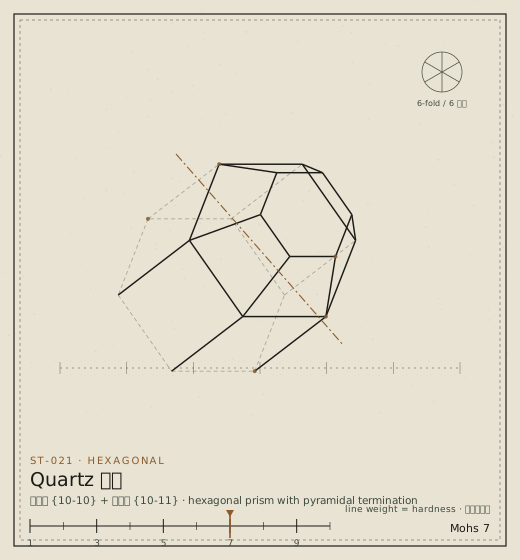
| ST-021 Minerals | Quartz石英 Quartz is the most useful single mineral in field identification, not because it is interesting to look at but because of what its hardness does to everything else. At 7 on Mohs' scale it si Mineral species | SiO₂ | 7 | |
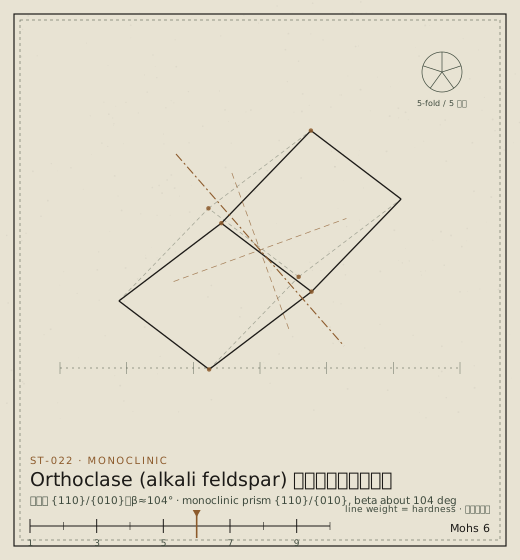
| ST-022 Minerals | Orthoclase (alkali feldspar)正长石(碱性长石) Orthoclase is the alkali feldspar — potassium aluminium silicate — and it is the mineral responsible for the pink colour of most granite. Its name means "right-angle fracture", referring to Mineral species | KAlSi₃O₈ | 6 | |
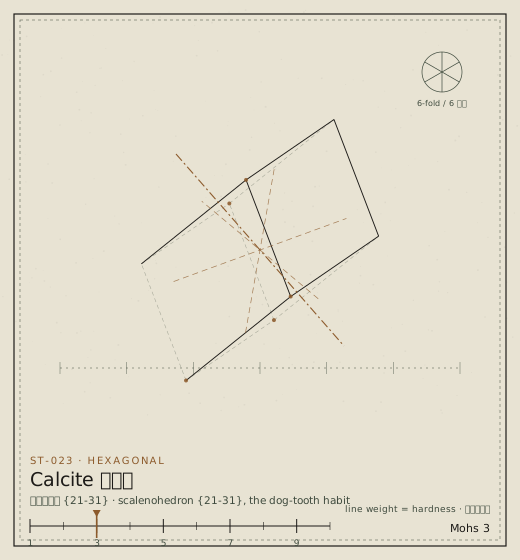
| ST-023 Minerals | Calcite方解石 Calcite is the reference mineral for hardness 3, the fizz in an acid test, and above all for cleavage — three perfect directions that break a crystal into rhombs and make calcite one of the Mineral species | CaCO₃ | 3 | |
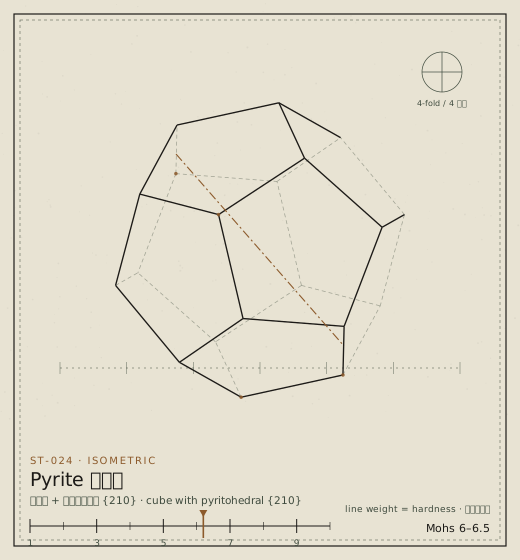
| ST-024 Minerals | Pyrite黄铁矿 Pyrite is the mineral that built the phrase "fool's gold", and the deception works because pyrite genuinely looks metallic and golden in a stream bed. It is iron disulfide, the most common s Mineral species | FeS₂ | 6–6.5 | |
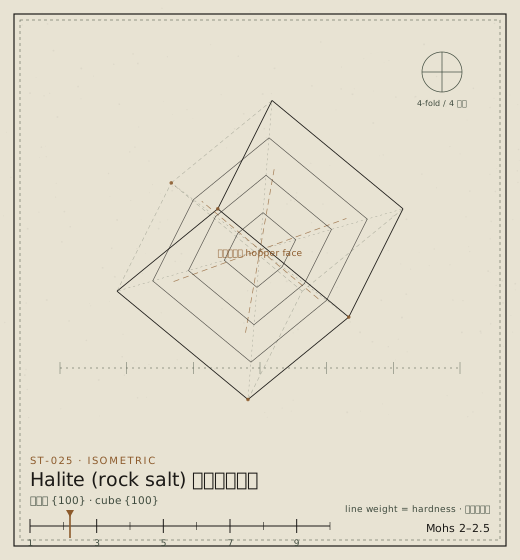
| ST-025 Minerals | Halite (rock salt)石盐(岩盐) Halite is sodium chloride — table salt — and it is the one common mineral for which taste is a legitimate field test. It forms by evaporation, it cleaves into perfect cubes, and it is soft e Mineral species | NaCl | 2–2.5 | |
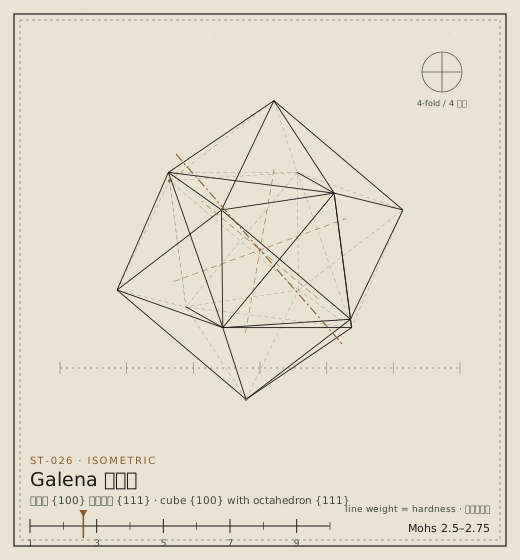
| ST-026 Minerals | Galena方铅矿 Galena is the main ore of lead, and it is one of the few minerals that announces itself by weight before you have looked at it properly. Pick it up and the density is startling — 7.6 grams p Mineral species | PbS | 2.5–2.75 |