Halite (rock salt)
石盐(岩盐)
Halite is sodium chloride — table salt — and it is the one common mineral for which taste is a legitimate field test. It forms by evaporation, it cleaves into perfect cubes, and it is soft enough that a fingernail will scratch it, which makes it straightforward to identify and unusually awkward to keep.
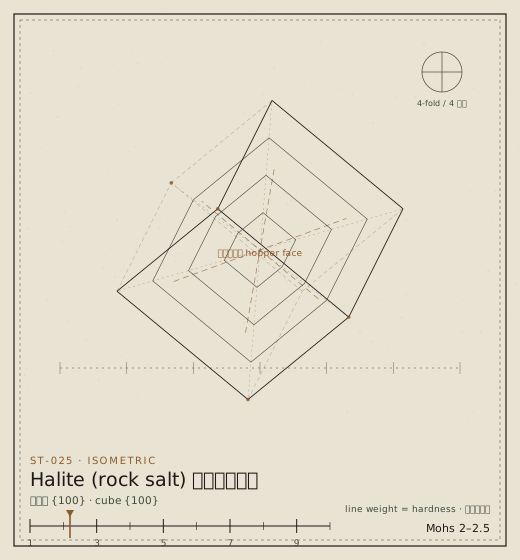
Specimen properties
| Sheet | ST-025 |
|---|---|
| Chemical formula | NaCl |
| Classification | Halide · evaporite卤化物 · 蒸发岩 |
| Hardness, Mohs | 2–2.5 |
| Streak | White白色 |
| Lustre | Vitreous on fresh cleavage faces; usually dull and slightly moist-looking in damp air新鲜解理面玻璃光泽;潮湿空气中通常暗淡并略显湿润 |
| Cleavage | Three perfect directions at 90°, producing cubes — the defining property三组 90° 完全解理,产生立方体——决定性性质 |
| Fracture | Conchoidal but rarely observed, since the mineral almost always parts on cleavage贝壳状但极少见,因为矿物几乎总沿解理裂开 |
| Colour | Colourless, white, pink, red, blue or grey; often banded in bedded deposits无色、白、粉、红、蓝或灰;层状矿床中常呈条带 |
| Crystal system | isometric |
| Crystal habit / fabric | cubic-hoppered · 4-fold · 3 cleavage dir. |
| Published | 2026-10-13 |
| Byline | By The Specimen Desk |
Related formulae
NaCl · KCl (as sylvite impurity) · CaSO₄·2H₂O (as gypsum)
Field tests, in order
Three right-angled cleavages
Halite's structure is a simple cubic lattice of sodium and chloride ions, and the bonds are equally weak in all three axis directions. The result is three perfect cleavages at 90 degrees (per Geology.com Mineral Encyclopedia), so a struck crystal yields small cubes. This is the same geometry as galena and fluorite's parent structure family, and it distinguishes halite immediately from calcite (rhombs at 75 degrees) and from quartz (no cleavage at all). Combined with hardness 2 to 2.5, taste, and solubility in water, halite is one of the fastest minerals in the field to confirm — but do not neglect the acid test, because a carbonate that happens to be cubic-looking will fizz while halite will not.
How evaporites form
Halite precipitates when a body of water becomes saturated in sodium chloride, which in practice means it is evaporating faster than it is being replenished. The sequence of salts that precipitates as seawater concentrates is fixed by solubility: calcium carbonate first, then gypsum, then halite, and finally the highly soluble potassium and magnesium salts. That order is why evaporite deposits are layered, with a carbonate base, a gypsum middle and a halite top, and it is why potash minerals only occur in the most concentrated parts of a basin. Ancient evaporites record vanished seas — the Permian Zechstein of northern Europe and the Messinian salt of the Mediterranean, deposited when the Mediterranean was cut off from the Atlantic about 5.5 million years ago, are the largest examples.
Salt structures and why they matter
Halite deforms plastically under pressure and is less dense than most overlying rock, so a buried salt layer flows upward and forms domes and walls, pushing the strata above it into folds and faults. This salt tectonics has two consequences that matter economically. Salt is impermeable, so a dome can trap oil and gas against its flanks, which is why salt domes are prime exploration targets along the Gulf of Mexico and in the North Sea. And a dome can also seal a repository — salt formations have been studied for decades as sites for nuclear waste disposal precisely because salt is impermeable, self-healing and dry.
Field occurrences
You meet halite in four settings. Modern salt lakes and sabkhas, where crusts form seasonally and can be studied as they grow. Bedded rock salt in sedimentary basins, quarried for road salt and for chemical feedstock. Salt domes, where the halite has risen and may be mined underground, as at Wieliczka in Poland. And as efflorescences on desert soils and on building stone in arid and coastal areas, where capillary water brings salt to the surface and evaporates — the same process that damages masonry.
Handling, storage and one warning
Halite is hygroscopic and deliquescent: in humid air it absorbs water and dissolves, and an unprotected specimen will eventually reduce itself to a puddle of brine that destroys its own label. Store specimens in sealed containers with silica gel and inspect them periodically. Because it is soft, halite also creeps under a specimen's own weight over years. The warning is about sampling: do not taste halite from mine workings, industrial spoil, road salt stockpiles or any deposit near a pollution source, since those settings can concentrate contaminants. Test the taste only on clean material you have collected from a natural evaporite.
Sources
Hardness, streak, cleavage and specific-gravity values quoted on this sheet are checked against the references below.
- Geology.com Mineral Encyclopedia — mineral property database — hardness, cleavage, streak, specific gravity and chemical composition per mineral
- National Park Service — U.S. National Park Service geology pages — mineral definition, physical properties and common minerals
- Tulane University — university mineralogy course notes (EENS 2110) — physical properties, hardness references, specific gravity
- Tulane University Crystallography — university mineralogy course notes — the 32 crystal classes and the crystal systems
Representative localities
Confused with, and how to separate them
Calcite cleaves into rhombs at 75°, is harder, tastes of nothing and fizzes in acid
Quartz is hexagonal, much harder, and cannot be scratched with a fingernail
Collecting and storage
Halite specimens are hygroscopic and deliquescent: in humid air they absorb water and slowly dissolve, and any specimen kept in an ordinary room will eventually turn to brine and ruin the label. Store sealed with silica gel, or accept that the collection is temporary. Do not taste material from mine spoil, road salt or any deposit near industry — halite from those settings can carry contamination. Salt deposits are also mobile: because halite flows plastically under pressure, salt domes rise through overlying rock and are a major trap for oil and gas, which is why salt tectonics is a subject in its own right.
Key points
- Three cleavages at 90 degrees produce cubes; calcite's rhombs at 75 degrees separate it at a glance.
- Hardness 2–2.5 means a fingernail scratches it — rare among common minerals.
- Evaporite sequences precipitate in a fixed order: carbonate, gypsum, halite, then potash salts.
- Salt flows plastically and forms domes that trap oil and gas and seal potential repositories.
- Halite is deliquescent; store it sealed with silica gel or lose it to brine.