Orthoclase (alkali feldspar)
正长石(碱性长石)
Orthoclase is the alkali feldspar — potassium aluminium silicate — and it is the mineral responsible for the pink colour of most granite. Its name means "right-angle fracture", referring to the two cleavage directions that meet at 90 degrees, and that single property makes it the easiest feldspar to recognise in the field.
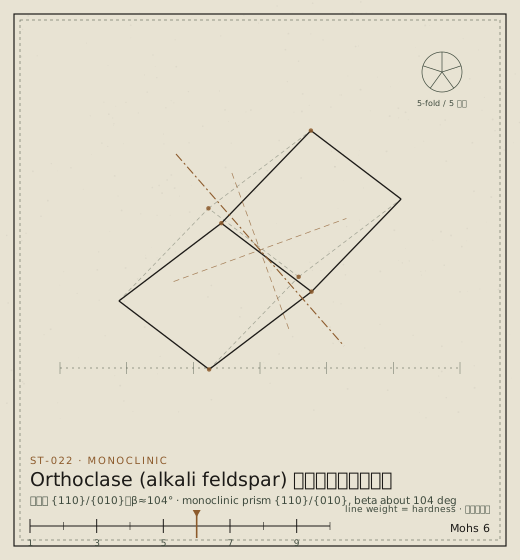
Specimen properties
| Sheet | ST-022 |
|---|---|
| Chemical formula | KAlSi₃O₈ |
| Classification | Tectosilicate · alkali feldspar架状硅酸盐 · 碱性长石 |
| Hardness, Mohs | 6 |
| Streak | White白色 |
| Lustre | Vitreous to pearly on cleavage faces; dull and chalky when altered解理面玻璃至珍珠光泽;蚀变后暗淡呈白垩状 |
| Cleavage | Two directions at 90° — the source of the name "right-angle fracture"两组 90° 解理——「正长」之名的由来 |
| Fracture | Uneven to subconchoidal; brittle不平坦至亚贝壳状;性脆 |
| Colour | Cream, pink, flesh-red, white or colourless; green when it is amazonite米、粉、肉红、白或无色;天河石品种为绿色 |
| Crystal system | monoclinic |
| Crystal habit / fabric | prismatic-blocky · 5-fold · 2 cleavage dir. · twinned |
| Published | 2026-10-01 |
| Byline | By The Specimen Desk |
Related formulae
KAlSi₃O₈ · NaAlSi₃O₈ (albite component)
Field tests, in order
Two cleavages at ninety degrees
Feldspar is a framework silicate, and its crystal structure contains two planes of weakness at right angles. Break a crystal and you get a stepped surface with square corners — not the curved glassy fracture of quartz and not the three-direction rhombus of calcite. In practice this is the observation that resolves most feldspar identifications. Add the hardness: at 6 (per National Park Service), orthoclase is soft enough to take a white powder line from a steel knife, which immediately separates it from the quartz it is usually found next to.
Recognising the alteration state
Feldspar is chemically unstable at the surface, and the degree of alteration is genuinely useful information about how long a rock surface has been exposed.
- Fresh: glassy, slightly pearly on the cleavage face, with the cream or pink colour clearly visible.
- Partly altered: the surface turns opaque and cloudy white, and a hand lens shows tiny flakes of white mica (sericite) sitting on the cleavage planes.
- Fully kaolinised: soft, chalky, white, and it will rub off on your fingers. At this stage the feldspar is now largely kaolinite clay.
Twins, and why they are worth recording
Feldspar twins more readily than almost any other common mineral, and the twin laws are diagnostic. Carlsbad twins produce a single crystal divided into two halves with different orientations, giving a blocky specimen with an internal seam. Baveno twins share a single plane. Manebach twins give a characteristic flattening. In thin section, the alternating light and dark stripes of albite twinning are the standard way plagioclase is identified, and the geometry of the twinning is what lets petrologists determine the composition of a plagioclase grain without a chemical analysis.
Where it comes from and what it becomes
Orthoclase crystallises from silica-rich melts and is one of the two main feldspars in granite, granodiorite and rhyolite, along with plagioclase. The largest and best-formed crystals come from pegmatites, where water-rich residual melt allows crystals to grow for a long time in open cavities; crystals over a metre across occur. When orthoclase is heated above about 500 degrees Celsius it becomes disordered and is properly called sanidine, the high-temperature form found in volcanic rocks; cool it slowly and it becomes microcline, which is what most orthoclase in ancient granites actually is, and which shows a distinctive cross-hatched twinning pattern under the microscope. The green variety, amazonite, gets its colour from lead and water in tiny amounts within the crystal structure — a colour that fades if the crystal is heated.
A mineral that matters economically
Feldspar is quarried in large quantities for the glass and ceramics industries: it acts as a flux, lowering the melting temperature of the silica mix and providing aluminium at the same time. Most commercial feldspar comes from pegmatites, which can be mined for feldspar, mica and quartz simultaneously. As a field collector, the useful habit is to note the twin law, the alteration state and the associated minerals — a pegmatite with large orthoclase, muscovite and quartz is a classic combination, and the presence of beryl, tourmaline or tantalite in the same body is what makes such outcrops worth reporting.
Sources
Hardness, streak, cleavage and specific-gravity values quoted on this sheet are checked against the references below.
- Geology.com Mineral Encyclopedia — mineral property database — hardness, cleavage, streak, specific gravity and chemical composition per mineral
- Geology.com Mohs Hardness Scale — reference article by a PhD geologist — Mohs scale, field hardness tests, hardness of common minerals
- National Park Service — U.S. National Park Service geology pages — mineral definition, physical properties and common minerals
- Tulane University Silicate Structures — university mineralogy course notes — crustal element abundance and silicate structural groups
Representative localities
Confused with, and how to separate them
Similar colour and both vitreous, but quartz has no cleavage, is harder, and does not scratch with steel
Both cleave into regular blocks, but calcite's cleavage angle is 75° and it fizzes in acid
Not a mineral confusion but a rock one: the pink grains in granite are usually orthoclase, which is why the rock looks pink
Collecting and storage
Feldspar alters quickly at the surface: the feldspar in an exposed granite turns chalky white within a few decades as it converts to kaolinite and sericite. Fresh material only exists below the weathering rind, so break a block open rather than collecting the coloured surface. Good crystals come from pegmatites and from Alpine-type fissures; where those are on protected land, photograph rather than extract.
Key points
- Two cleavages at 90 degrees produce a blocky, stepped break — the defining field test.
- Hardness 6 means a steel knife leaves a white powder line, unlike quartz.
- Alteration state runs from glassy and fresh, through sericite-flecked, to soft kaolinite.
- Most orthoclase in ancient granites has inverted to microcline with cross-hatched twinning.
- Feldspar is quarried as a flux for glass and ceramics, mostly from pegmatites.