Pyrite
黄铁矿
Pyrite is the mineral that built the phrase "fool's gold", and the deception works because pyrite genuinely looks metallic and golden in a stream bed. It is iron disulfide, the most common sulfide mineral on Earth, and once you know three tests it is one of the easiest minerals to identify — the trick is remembering to run them.
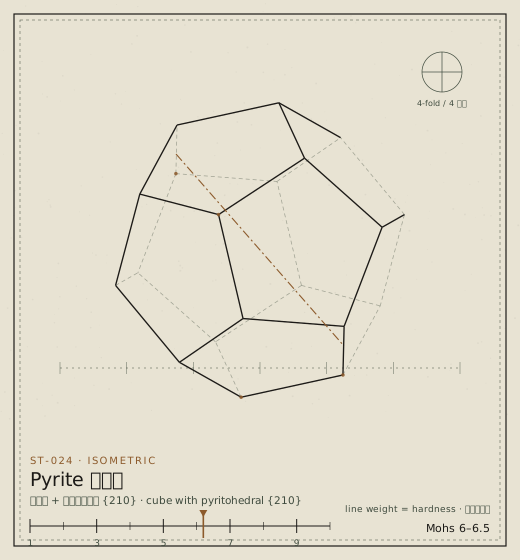
Specimen properties
| Sheet | ST-024 |
|---|---|
| Chemical formula | FeS₂ |
| Classification | Sulfide · iron disulfide硫化物 · 二硫化铁 |
| Hardness, Mohs | 6–6.5 |
| Streak | Greenish black to brownish black — the single most useful test against gold绿黑至褐黑色——与黄金区分时最有用的单项测试 |
| Lustre | Metallic, bright and brassy on fresh surfaces; tarnishes to dull brown金属光泽,新鲜面明亮呈黄铜色;氧化后变暗褐色 |
| Cleavage | None; pyrite breaks with an uneven conchoidal fracture无解理;黄铁矿呈不平坦的贝壳状断口 |
| Fracture | Uneven to conchoidal, brittle; edges may be sharp不平坦至贝壳状,性脆;边缘可能锋利 |
| Colour | Pale brass-yellow to golden; tarnishes to brown or iridescent purple浅黄铜色至金黄色;氧化后呈褐色或彩虹色紫 |
| Crystal system | isometric |
| Crystal habit / fabric | cubic-pyritohedral · 4-fold · 0 cleavage dir. · twinned |
| Published | 2026-08-31 |
Related formulae
FeS₂ · FeS₂ var. marcasite (polymorph)
Field tests, in order
Three tests that never fail
Gold and pyrite differ in every measurable property, and each difference is a test you can run in the field.
| Property | Pyrite | Gold |
|---|---|---|
| Streak on unglazed tile | Greenish black to brownish black | Golden yellow |
| Hardness | 6–6.5, a knife barely marks it | 2.5–3, a knife cuts it easily |
| Response to a hammer | Shatters, sparks, sulphurous smell | Flattens into a sheet without breaking |
| Crystal form | Cubes, pyritohedra, striated faces | Irregular flakes and nuggets, no crystal faces |
| Density | About 5 g/cm³ | About 19 g/cm³ — four times heavier in the hand |
Crystal forms and the striated cube
Pyrite crystallises in the cubic system, and well-formed crystals are common because it grows easily in open cavities and in sedimentary environments. The most familiar habit is the cube, with faces that are almost always striated — the parallel lines on each face run in different directions on adjacent faces, which is a reliable identification feature. Pyritohedra, with twelve five-sided faces, are almost as common and are structurally unique among common minerals. Navajún in Spain produces cubes up to 20 centimetres across, sitting free in marl and needing no preparation. In sedimentary rocks pyrite also forms framboids — raspberry-shaped aggregates of microcrystals a few micrometres across — which are a signature of bacterial sulfate reduction in anoxic mud.
How pyrite forms and what it signals
Pyrite forms wherever iron meets sulfide under reducing conditions. In anoxic mud, sulfate-reducing bacteria convert sulfate to sulfide, which reacts with iron to make pyrite, and this is why black shales and coal seams are full of it. In hydrothermal veins, pyrite precipitates alongside gold, quartz, galena and sphalerite, and it is the most common gangue sulfide in ore deposits — many gold mines are pyrite mines with trace gold locked inside the pyrite lattice, which is why refractory gold ore requires oxidation before the gold can be extracted. In metamorphic rocks, pyrite is a common accessory that survives moderate heating.
Pyrite decay: the collector's enemy
Pyrite is chemically unstable in the presence of oxygen and water. The reaction produces ferrous sulfate and sulfuric acid, and the acid then attacks everything around it. The visible result is a white or yellow efflorescence on the specimen, then crumbling, then a brown stain that spreads to the label and the storage box. Some pyritic specimens are stable for decades and others disintegrate in a year, depending on crystal size, trace elements such as arsenic, and the humidity of the store. The practical rules are straightforward: dry specimens thoroughly before storage, keep humidity low with silica gel, inspect collections annually, and isolate any specimen that starts to show a white bloom. This is not just a collection problem — the same chemistry produces acid mine drainage, one of the most persistent environmental problems associated with metal mining, and it is why pyritic spoil heaps are a management concern rather than just a landform.
Field safety
Pyrite itself is not acutely toxic, but pyritic rocks can be hazardous in two ways. Weathering produces acid, so do not store acid-generating rock in a garden or near water courses, and wash hands after handling weathered material. More seriously, breaking pyrite-bearing rock that contains arsenic-bearing sulfides such as arsenopyrite releases dust containing arsenic, which is a cumulative poison. Wear a mask when hammering sulfide-rich rock and never heat or burn it — roasting sulfide minerals releases sulphur dioxide and toxic metal fumes.
Representative localities
Confused with, and how to separate them
Both are dark metallic minerals, but magnetite is magnetic, has a black streak and is not brassy
Hematite is harder to confuse by colour — it is steel-grey to red — and gives a red-brown streak
Collecting and storage
The one rule that matters: never collect pyrite with a wet hand into a sealed bag. Pyrite oxidises in humid air, producing sulphuric acid that destroys the specimen, the label and the box, a process called pyrite decay that has ruined museum collections. Dry specimens thoroughly, keep them at low humidity with silica gel, and store them away from anything metal. Pyrite-bearing rocks are also acidic when disturbed: acid mine drainage from pyrite oxidation is one of the most persistent forms of mining pollution.
Key points
- Streak colour settles the gold question instantly: greenish black for pyrite, golden for gold.
- Hardness 6–6.5 means a knife will not cut it; gold is soft enough to cut with a blade.
- Striated cube faces and pyritohedra with five-sided faces are characteristic crystal forms.
- Pyrite forms in anoxic mud by bacterial sulfate reduction and in hydrothermal veins with gold.
- Pyrite decay is a real storage hazard; keep specimens dry and monitor collections annually.