Galena
方铅矿
Galena is the main ore of lead, and it is one of the few minerals that announces itself by weight before you have looked at it properly. Pick it up and the density is startling — 7.6 grams per cubic centimetre against roughly 2.7 for quartz and feldspar — and from then on the bright silver cubic cleavage confirms it.
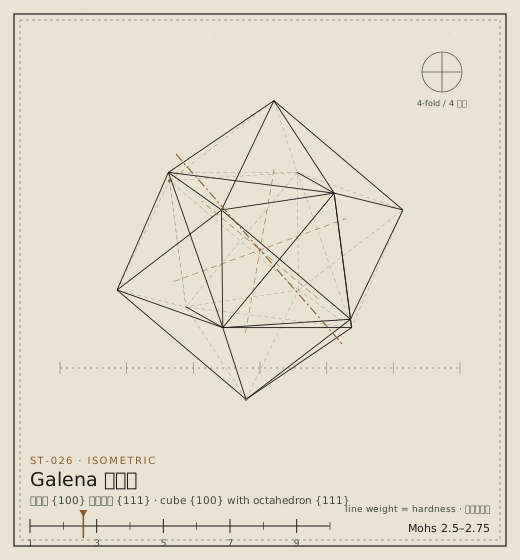
Specimen properties
| Sheet | ST-026 |
|---|---|
| Chemical formula | PbS |
| Classification | Sulfide · lead sulfide硫化物 · 硫化铅 |
| Hardness, Mohs | 2.5–2.75 |
| Streak | Lead-grey to black, with a metallic sheen铅灰至黑色,带金属光泽 |
| Lustre | Metallic, bright and silvery on fresh cleavage faces; dulls quickly in air金属光泽,新鲜解理面明亮呈银色;在空气中很快变暗 |
| Cleavage | Three perfect directions at 90°, so it breaks into cubes — but the mineral is so soft the edges bruise三组 90° 完全解理,裂成立方体——但矿物太软,棱角易碰伤 |
| Fracture | Subconchoidal; rarely seen because cleavage dominates亚贝壳状;因解理占主导而少见 |
| Colour | Lead-grey to silver-grey; tarnishes to a dull blue-grey or iridescent film铅灰至银灰;氧化后呈暗蓝灰或彩虹色薄膜 |
| Crystal system | isometric |
| Crystal habit / fabric | cubic-octahedral · 4-fold · 3 cleavage dir. · twinned |
| Published | 2026-10-25 |
| Byline | By The Specimen Desk |
Related formulae
PbS · PbS with Ag (argentiferous) · PbSO₄ (as anglesite, the alteration product)
Field tests, in order
Why galena feels wrong in the hand
Specific gravity is an underused field test, but it catches minerals that look like nothing else. Galena contains lead, the heaviest common metal, and its structure packs the atoms densely: 7.6 g/cm³ is comparable to many metal ores and is roughly three times the density of quartz. The practical version of the test is simple — compare the specimen against a piece of granite or quartz of similar size, and if it feels two or three times heavier, you are dealing with a dense sulfide or oxide. The same test flags magnetite (5.2), hematite (5.3), barite (4.5) and, in the extreme case, native metals such as galena's cousin lead itself, at 11.3.
The tarnish film
Fresh galena is bright metallic silver, but this lasts only days to weeks in a display case. The surface oxidises to a dull blue-grey film, then to iridescent colours, and eventually to anglesite (lead sulfate) or cerussite (lead carbonate). For a collector this matters practically: photograph specimens when they are fresh, keep them in a closed container with desiccant, and handle them by the edges to slow the process. Tarnished galena is not damaged in any permanent sense — the film can be removed — but each cleaning takes a little of the surface with it, so it is better to accept the tarnish than to polish repeatedly.
Where it forms
Galena precipitates from lead-bearing hydrothermal fluids, most often at moderate temperatures, and it occurs in three associations a field collector will meet.
- Mississippi Valley-type deposits: galena and sphalerite in limestone and dolostone, often with a chert host, formed from basinal brines at low temperature. These are the classic cube-on-chert specimens.
- Skarn and replacement deposits: galena with sphalerite, chalcopyrite and magnetite where hot fluids reacted with limestone near an intrusion. Dalnegorsk and many Chinese lead-zinc mines are of this type.
- Veins: galena with quartz, barite and fluorite in fractures, often with visible silver content, which is why galena was historically also a silver ore.
From ore to metal, and the lead problem
Galena is the principal ore of lead worldwide because it is easy to concentrate and easy to smelt: roast it to lead oxide, then reduce with carbon in a furnace. It very often carries silver as a substitution in the crystal lattice — argentiferous galena — which is why lead mining and silver mining have been the same industry for most of history. The environmental legacy is severe. Lead is a cumulative neurotoxin with no safe blood level in children, and historic smelting has left contaminated soil around mining towns on every continent. Modern operations control dust and stack emissions tightly, but the reason lead is now heavily regulated is precisely the record of what unregulated galena mining did to the people who lived next to it.
Collecting safely
Treat galena as you would any lead compound. Never sand, saw or grind it — that generates respirable lead sulfide dust — and do not heat it, since roasting releases lead and sulfur dioxide fumes. Wash hands after handling. Store specimens out of reach of children, and do not keep large quantities in a living space. If you are collecting on mine spoil, remember that the spoil also carries cadmium and arsenic from associated sulfides, and that old workings may be unstable and poorly ventilated.
Sources
Hardness, streak, cleavage and specific-gravity values quoted on this sheet are checked against the references below.
- Geology.com Mineral Encyclopedia — mineral property database — hardness, cleavage, streak, specific gravity and chemical composition per mineral
- Tulane University — university mineralogy course notes (EENS 2110) — physical properties, hardness references, specific gravity
- Geology.com Mohs Hardness Scale — reference article by a PhD geologist — Mohs scale, field hardness tests, hardness of common minerals
Representative localities
Confused with, and how to separate them
Both are dark metallic minerals, but magnetite is strongly magnetic and much harder
Hematite is harder, gives a red-brown streak and lacks galena's cubic cleavage
Collecting and storage
Galena is lead sulfide, and lead is a cumulative poison. Wash hands thoroughly after handling, never eat or drink while collecting, and do not store galena specimens in a bedroom or anywhere children can reach them. Do not grind or sand galena — the dust is the real hazard — and do not acid-treat it. Many museum curators keep galena in a separate drawer because specimens are soft enough to bruise each other and because the tarnish film can transfer to adjacent labels.
Key points
- Galena's density of 7.6 g/cm³ (per Geology.com Mineral Encyclopedia) makes weight alone a reliable first test.
- Three perfect 90-degree cleavages give silver cubes; hardness 2.5–2.75 cuts easily.
- Fresh surfaces tarnish within weeks; store with desiccant and photograph while fresh.
- It occurs in Mississippi Valley-type deposits, skarns and silver-bearing veins.
- Lead is a cumulative poison — never grind, heat or casually handle galena.