Metamorphic rocks and minerals
The same protolith at different grades: shale becomes slate, then phyllite, then schist, then gneiss, and each step is readable.
| Sheet | Name | Formula | Mohs | |
|---|---|---|---|---|
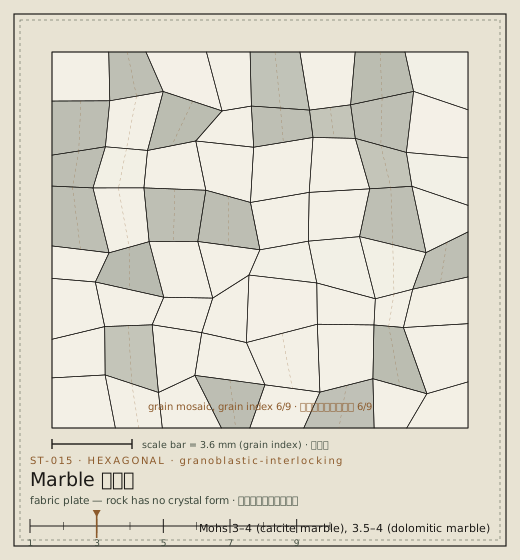
| ST-015 Metamorphic | Marble大理岩 Marble is limestone that has been cooked. Given enough heat and pressure, calcite grains recrystallise into a dense interlocking mosaic, the fossils and bedding are destroyed, and the rock b Hand specimen | Recrystallised CaCO₃; dolomitic marble is CaMg(CO₃)₂ | 3–4 (calcite marble), 3.5–4 (dolomitic marble) | |
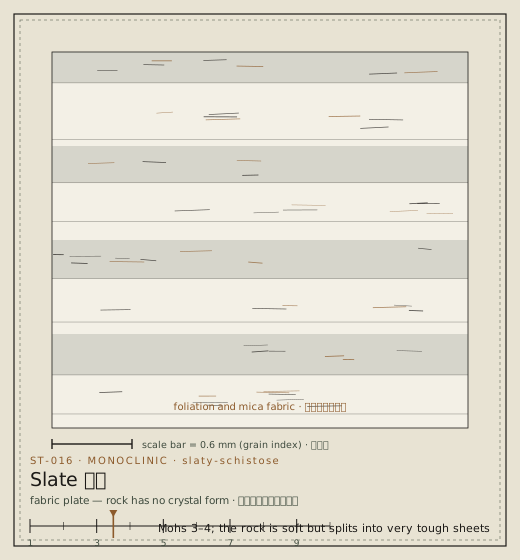
| ST-016 Metamorphic | Slate板岩 Slate is the grade of metamorphosed mud that industry was built on: it splits into thin waterproof sheets, which made it the roofing material of eighteenth- and nineteenth-century Europe and Hand specimen | Fine-grained white mica (sericite), chlorite and quartz after a shale protolith | 3–4; the rock is soft but splits into very tough sheets | |
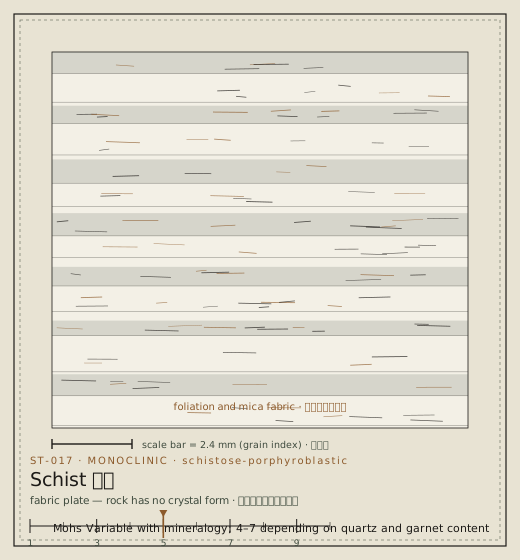
| ST-017 Metamorphic | Schist片岩 Schist is the middle grade of regional metamorphism — hot enough, roughly 400 to 600 degrees Celsius, for mica to grow into flakes you can see and for new minerals to crystallise that carry Hand specimen | Variable: muscovite, biotite, chlorite, quartz, feldspar, garnet, staurolite, kyanite | Variable with mineralogy; 4–7 depending on quartz and garnet content | |
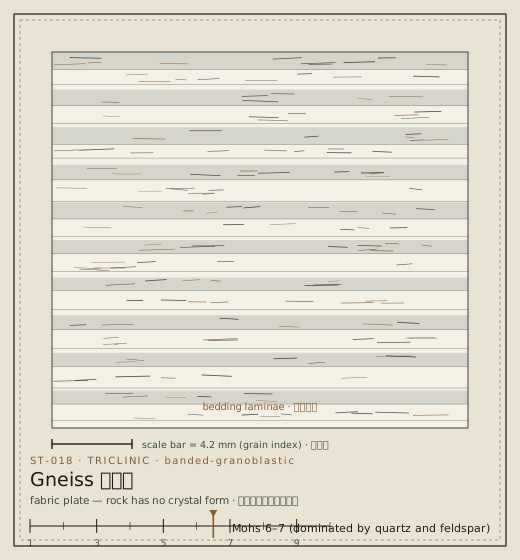
| ST-018 Metamorphic | Gneiss片麻岩 Gneiss is the highest grade of common metamorphic rock, formed at temperatures above about 600 degrees Celsius and often at pressures corresponding to 20 to 30 kilometres of burial. Its defi Hand specimen | Quartz + feldspar + biotite or hornblende, segregated into light and dark bands | 6–7 (dominated by quartz and feldspar) | |
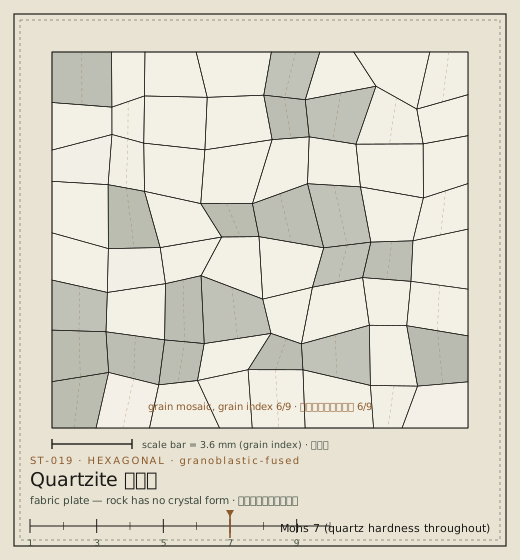
| ST-019 Metamorphic | Quartzite石英岩 Quartzite is what happens to a pure quartz sandstone when it is buried deeply enough that the grains recrystallise and weld together. The cement disappears, the grain boundaries heal, and th Hand specimen | SiO₂, recrystallised from a quartz sandstone protolith | 7 (quartz hardness throughout) |