Quartz
石英
Quartz is the most useful single mineral in field identification, not because it is interesting to look at but because of what its hardness does to everything else. At 7 on Mohs' scale it sits above steel, above glass and above every common carbonate and sulphate, which makes it a reference point you can carry in your pocket and use to bracket anything unknown.
Specimen properties
| Sheet | ST-021 |
|---|---|
| Chemical formula | SiO₂ |
| Classification | Tectosilicate · framework silicate架状硅酸盐 |
| Hardness, Mohs | 7 |
| Streak | White; quartz is harder than a streak plate and usually leaves only a scratch on it白色;石英比条痕板更硬,通常只在板上留下划痕 |
| Lustre | Vitreous on crystal faces, greasy on fracture surfaces, waxy in chalcedony晶面玻璃光泽,断口油脂光泽,玉髓呈蜡状光茶 |
| Cleavage | None in the ordinary sense. Quartz breaks with no flat faces, which is why it looks like broken glass通常意义下无解理。石英破裂时没有平整面,因此看起来像碎玻璃 |
| Fracture | Conchoidal, with curved surfaces and sharp edges贝壳状,具曲面与锋利边缘 |
| Colour | Colourless, white, grey, smoky, purple (amethyst), yellow (citrine), pink (rose)无色、白、灰、烟色、紫(紫晶)、黄(黄晶)、粉(芙蓉石) |
| Crystal system | hexagonal |
| Crystal habit / fabric | prismatic-hexagonal · 6-fold · 0 cleavage dir. · twinned |
| Published | 2026-08-22 |
Related formulae
SiO₂ · SiO₂ var. chalcedony · SiO₂·nH₂O var. opal
Field tests, in order
Why hardness 7 matters so much
Mohs' scale is ordinal, not linear, but the practical divisions matter more than the numbers. Below 2.5 you can scratch with a fingernail. Between 3 and 4, a copper coin works. Above 5.5 you need hardened steel. At 7, ordinary tools stop working: a knife leaves a metal streak and no groove, and a steel file skates. In the field this gives quartz a diagnostic role. Any colourless, translucent mineral that a knife cannot touch and acid does not affect is almost certainly quartz, and the two tests take fifteen seconds.
The habit: hexagonal prism with a pyramid
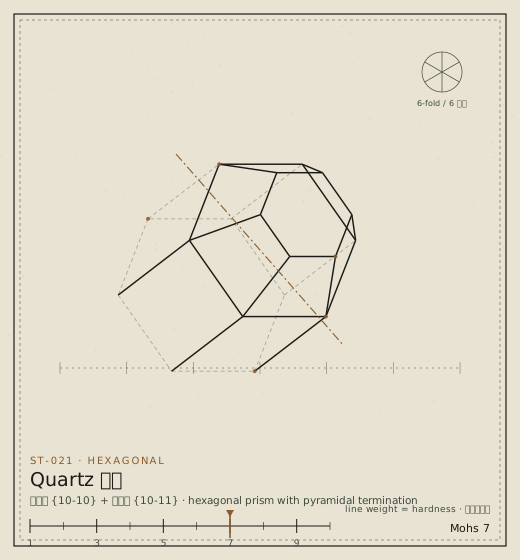
Where quartz grew into open space it developed its full crystal form, and that form is unambiguous. Look for a six-sided prism terminating in a six-sided pyramid; the prism faces are usually striated horizontally, and the pyramid faces are smooth. Twinning is common and produces Japan-law twins (two crystals crossing at a shallow angle) and Dauphiné twins (which require etching to see). Most quartz you find, however, grew in a confined space and has no crystal faces at all — it is a shapeless mass filling a vein, and there the only way to identify it is the hardness and cleavage tests.
The varieties, and what colours them
Most quartz varieties are the same mineral with different trace elements or defects.
| Variety | Colour | Cause |
|---|---|---|
| Rock crystal | Colourless | No significant trace elements or defects |
| Amethyst | Purple | Iron substituting for silicon, then gamma irradiation |
| Citrine | Yellow to orange | Iron, in a different oxidation state from amethyst |
| Smoky quartz | Brown to black | Natural or artificial gamma irradiation of aluminium-bearing quartz |
| Rose quartz | Pink | Trace titanium, iron or manganese; usually massive with no crystal form |
| Chalcedony / agate | Variable, banded | Fibrous microcrystalline quartz; agate is the banded form |
| Chert / flint | Grey to black | Microcrystalline quartz with organic matter and water |
Where it forms and what it tells you
Quartz is the second most abundant mineral in the continental crust and it precipitates wherever silica-rich fluids cool or become supersaturated. Three settings matter for a field collector. Hydrothermal veins fill fractures with quartz plus whatever metals the fluid carried — most gold and silver deposits are hosted in quartz veins, which is why prospectors look for the white outcrops first. Pegmatites are the last, water-rich dregs of a granitic melt and contain the largest crystals: prismatic quartz over a metre long occurs in some Brazilian and Malagasy pegmatites. And sedimentary quartz is the end product of everything else weathering away, since quartz survives chemical attack and abrasion better than any other common mineral, which is why sand is mostly quartz and why sandstones and quartzites are so quartz-rich.
Field hazards and good practice
Quartz fractures with sharp edges and produces a fine crystalline dust that is a genuine respiratory hazard over years of exposure. Trim specimens outdoors or with dust extraction, and wear eye protection when breaking anything. Do not test hardness by scratching a museum or protected outcrop specimen, and do not use a quartz crystal to scratch glass you do not own. For the notebook, record the crystal form and habit, whether the specimen is clear or cloudy, the presence of any inclusions or growth zoning, and the host rock — a quartz crystal's value to a collector is mostly in where it came from.
Representative localities
Confused with, and how to separate them
Both can be colourless and transparent, but calcite is 3 on Mohs, fizzes in acid, and shows perfect rhombohedral cleavage
Halite is cubic, tastes of salt and cleaves into cubes; quartz is hexagonal and tasteless
Collecting and storage
Quartz dust causes silicosis, so do not break specimens in a confined space and consider a mask when trimming. In the field, quartz is best recognised by what it refuses to do: it will not scratch with a knife, will not fizz in acid and will not show a flat cleavage face. Alpine-type fissure crystals are protected at many classic localities, so check local rules before extracting anything still attached to a wall.
Key points
- Hardness 7 puts quartz above steel and above most common minerals; a knife cannot scratch it.
- It has no cleavage, so it fractures with curved glassy surfaces and sharp edges.
- Free-grown quartz forms a six-sided prism ending in a pyramid, with horizontal striations.
- Most colour varieties are trace-element or radiation effects on the same SiO₂.
- Quartz vein outcrops host most precious-metal deposits, which is why prospectors hunt them first.