Calcite
方解石
Calcite is the reference mineral for hardness 3, the fizz in an acid test, and above all for cleavage — three perfect directions that break a crystal into rhombs and make calcite one of the few minerals you can identify by how it falls apart.
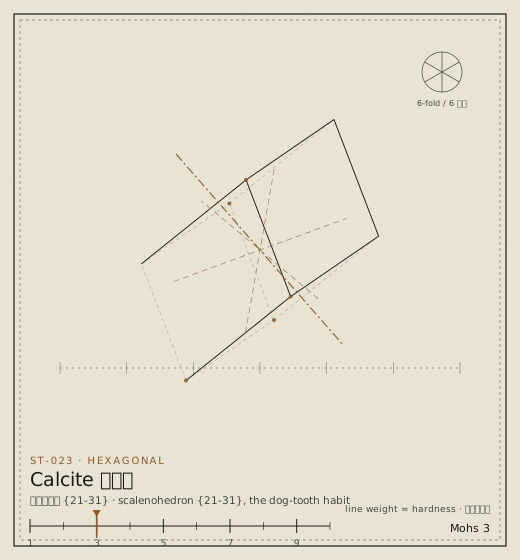
Specimen properties
| Sheet | ST-023 |
|---|---|
| Chemical formula | CaCO₃ |
| Classification | Carbonate · anhydrous碳酸盐 · 无水 |
| Hardness, Mohs | 3 |
| Streak | White to pale grey白色至浅灰 |
| Lustre | Vitreous to pearly; transparent varieties show strong double refraction玻璃至珍珠光泽;透明品种双折射强烈 |
| Cleavage | Three perfect directions forming rhombs at 75° — the most recognisable cleavage in mineralogy三组完全解理构成 75° 菱面体——矿物学中最具辨识度的解理 |
| Fracture | Conchoidal but rarely seen, because the rock usually parts along cleavage贝壳状但少见,因为岩石通常沿解理裂开 |
| Colour | Colourless, white, cream, grey, green, blue, pink, orange无色、白、米、灰、绿、蓝、粉、橙 |
| Crystal system | hexagonal |
| Crystal habit / fabric | rhombohedral-scalenohedral · 6-fold · 3 cleavage dir. · twinned |
| Published | 2026-09-15 |
Related formulae
CaCO₃ · (Ca,Mg)CO₃ · CaCO₃ var. aragonite (polymorph)
Field tests, in order
The rhomb is the identification
Calcite's structure has three directions of weakness, each at an oblique angle to the others, so a struck crystal splits into rhombohedra rather than cubes or blocks. That single property distinguishes it from halite, which cleaves into cubes at 90 degrees, from fluorite, which cleaves into octahedra, and from feldspar, which gives two directions at 90 degrees. If you can break the mineral, the shape of the fragments tells you what it is before you do anything else. Calcite is also polymorphous: the same chemistry crystallises as aragonite with a different structure, and aragonite is what most mollusc shells and corals are made of, though it slowly inverts to calcite over geological time.
Double refraction and Iceland spar
Place a clear calcite rhomb on a line of text and you see two lines. Because calcite crystallises in the hexagonal system but with a structure that is optically anisotropic, light entering it is split into two rays with different polarisations and different speeds — ordinary and extraordinary. The result is a doubled image. The best natural material for showing this came from Helgustadir in Iceland, and "Iceland spar" became a standard optical component: polarising microscopes used calcite prisms to produce polarised light until cheaper synthetic polarisers replaced them. Iceland spar from Helgustadir was mined from the seventeenth century onward, and the locality is now protected.
The crystal habits you are likely to meet
Calcite has more recorded crystal forms than any other mineral, over 700, and the common ones are easy to tell apart once you know them.
| Habit | Appearance | Typical setting |
|---|---|---|
| Dog-tooth spar | Sharp scalenohedra, pointed like canine teeth | Veins and vugs in limestone |
| Nail-head spar | Flat-topped rhombohedra, wide and blunt | Sedimentary and hydrothermal cavities |
| Iceland spar | Large, clear, rhombohedral, colourless | Fissures in basalt (rare and protected) |
| Satin spar | Fibrous, silky, white, often in veins | Veins and cave floors |
| Marl / micrite | Fine white to grey powder or mud | Chalk and lime mud deposits |
| Onyx / travertine | Banded, layered, formed in hot springs | Spring deposits and caves |
Where calcite forms
Calcite is the most abundant carbonate mineral and it precipitates wherever calcium-rich water meets carbonate or loses carbon dioxide. Three settings produce most specimens. Sedimentary limestones are calcite precipitates or biological accumulations, and chalk is essentially pure calcite from coccoliths. Hydrothermal veins fill fractures in limestone and other rocks with coarse crystals, often accompanied by galena, sphalerite or fluorite. And caves produce speleothems — stalactites, stalagmites, flowstone — as dripping water degasses and precipitates calcite. Because speleothem layers vary with rainfall and temperature, they are a major source of palaeoclimate data, and the uranium-thorium dating of calcite is one of the workhorses of Quaternary science.
Testing, collecting and a caution
The acid test should be done on a fresh broken surface, not a weathered one, and the acid bottle should be small and kept away from everything else — a leak will destroy a notebook and etch a camera lens. Calcite is soft and cleaves easily, so specimens bruise if they are packed loose. Caves are protected environments in most jurisdictions and their formations are non-renewable: taking a stalactite is not collecting, it is vandalism, and it is illegal in most countries including China and the United States.
Representative localities
Confused with, and how to separate them
Both can be clear and colourless, but calcite is much softer, fizzes, and cleaves into rhombs
Dolomite is slightly harder and reacts only weakly to cold acid; the powder test separates them
Halite is cubic, tastes salty and cleaves into cubes rather than rhombs
Collecting and storage
Calcite is soft enough to be scratched by a fingernail in thin edges, so specimens abrade against each other in a bag; wrap them individually. The most rewarding calcite to collect is not the museum-grade crystal but the variety: more than 700 crystal forms are known, and the same mineral produces dog-tooth spar, nail-head spar, Iceland spar and the fibrous satin spar of a cave floor. Caves and their speleothems are protected in most countries and removing a stalactite destroys a record that took thousands of years to accumulate.
Key points
- Three perfect cleavages at 75 degrees produce rhombs; that geometry identifies calcite in seconds.
- Hardness 3, easily scratched by a copper coin, and vigorous fizzing in cold dilute acid.
- Clear calcite doubled text — double refraction — and made Iceland spar a standard optical material.
- It has more crystal habits than any other mineral: dog-tooth, nail-head, satin spar and more.
- Speleothems are datable climate archives; collecting them in caves is illegal in most countries.