Slate
板岩
Slate is the grade of metamorphosed mud that industry was built on: it splits into thin waterproof sheets, which made it the roofing material of eighteenth- and nineteenth-century Europe and North America. Its one essential field property is that the cleavage you split it along is not the bedding it was deposited with.
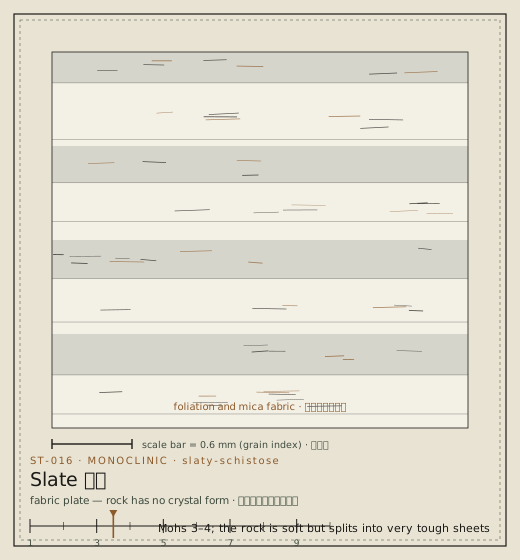
Specimen properties
| Sheet | ST-016 |
|---|---|
| Chemical formula | Fine-grained white mica (sericite), chlorite and quartz after a shale protolith |
| Classification | Metamorphic · low-grade foliated变质岩 · 低级叶理 |
| Hardness, Mohs | 3–4; the rock is soft but splits into very tough sheets |
| Streak | Grey, dull; harder to raise than shale灰色、暗淡;比页岩更难留下条痕 |
| Lustre | Dull to slightly silky on the cleavage surface暗淡至略带丝绢光泽的劈理面 |
| Cleavage | One perfect slaty cleavage that cuts across the original bedding — the defining feature一组极完全板劈理,斜切原始层理——决定性特征 |
| Fracture | Splits into sheets 1–10 mm thick with flat, even surfaces裂成 1–10 毫米厚的薄板,表面平整 |
| Colour | Dark blue-grey, grey, green-grey, purple or black深蓝灰、灰、绿灰、紫或黑色 |
| Crystal system | monoclinic |
| Crystal habit / fabric | slaty-schistose · 2-fold · 1 cleavage dir. |
| Published | 2026-09-07 |
Related formulae
KAl₂(AlSi₃O₁₀)(OH)₂ · (Mg,Fe)₅Al(AlSi₃O₁₀)(OH)₈ · SiO₂
Field tests, in order
Slaty cleavage is not bedding
Shale and slate look superficially similar and split in superficially similar ways, but they split for entirely different reasons. Shale splits along the bedding planes it was deposited with. Slate splits along a cleavage that formed afterwards, as directed pressure flattened the clay minerals and caused new mica to grow with its flat faces perpendicular to the stress. The two planes are generally inclined to each other, and if you can see both on one specimen — a colour lamination crossing a flat split surface at an angle — you have proof of metamorphism without needing a microscope. An even better feature is a crenulation: a second cleavage folding the first into a corrugation.
What happened to the rock
Slate occupies the lowest grade of regional metamorphism, roughly 200 to 400 degrees Celsius. The clay minerals that made up the shale do not survive; illite and kaolinite break down and sericite, a fine white mica, grows in their place, along with chlorite and recrystallised quartz. Nothing coarsens enough to be visible to the naked eye, which is why slate stays dull and smooth — the grain size is below 0.1 millimetre. Grade, not composition, is what separates slate from phyllite and from schist, and the boundary is defined by what you can see: invisible grains in slate, a silky sheen in phyllite, visible mica in schist.
Commercial slate and why the quality varies
Not all slate is good slate. A quarry's product is judged on three things: how evenly it splits, how far the cleavage plane persists across a block, and how resistant the sheets are to weathering.
| Property | What controls it | Field sign |
|---|---|---|
| Even splitting | Uniform mica growth, minimal quartz segregation | Flat matte surfaces, consistent sheet thickness |
| Block size | Continuity of the cleavage domain | Long unbroken panels in the spoil, few cross-fractures |
| Durability | Low carbonate content; high mica, low calcite | Rings under the hammer; does not effervesce in acid |
| Colour | Iron and organic content of the original mud | Blue-grey, purple, green and black all occur within one quarry |
Where it is found and what to record
Slate belts track ancient mountain belts that have since been eroded flat — North Wales, Vermont and New York, the Ardennes, the Iberian Pyrenees, Jiangxi and Anhui in China. Because the metamorphic grade is low, original sedimentary features often survive: graded bedding, colour lamination and even trace fossils can be visible in a freshly split sheet, and those are the details worth recording. Measure the angle between the cleavage and the bedding on any specimen that shows both, note the cleavage dip and strike, and record whether a second crenulation cleavage is present. That one set of measurements is enough to reconstruct the regional compression direction.
Handling and hazards
Fresh slate edges are sharp enough to cut and the material is brittle, so wear gloves when splitting and never use slate rubble as a hammering surface. Abandoned slate quarries present real hazards: unstable spoil slopes, deep water-filled pits and unsupported tunnel entrances. Slate itself is chemically inert and safe to handle; slate dust from sawing is a respiratory irritant and a source of crystalline silica, so do not dry-cut it indoors.
Representative localities
Confused with, and how to separate them
Both split into sheets, but shale splits along bedding and is softer and duller
Phyllite is the next grade up: its cleavage surfaces are crinkled and glossy rather than flat and matte
Collecting and storage
Slate splits into panels under a light hammer, and the panels are what make it useful — so select for large, clean sheets rather than collecting rubble. Historic slate quarries are often Scheduled Monuments or heritage sites; slate waste tips from abandoned quarries are the best collecting grounds and are usually open. Because slate was the roofing material of the industrial era, a piece of worked slate with a nail hole is common in old tips and worth keeping as a record of the trade.
Key points
- Slaty cleavage cuts across the original bedding — that distinction defines the rock.
- It forms at low metamorphic grade by growth of fine mica from clay minerals; grain size stays under 0.1 mm.
- Quality is judged by evenness of split, panel size, durability and colour consistency.
- Measuring the angle between cleavage and bedding reconstructs the compression direction.
- Slate rings under the hammer and does not fizz in acid; both are useful quick tests.