Gneiss
片麻岩
Gneiss is the highest grade of common metamorphic rock, formed at temperatures above about 600 degrees Celsius and often at pressures corresponding to 20 to 30 kilometres of burial. Its defining feature is not a mineral but a structure: light and dark bands, centimetres thick, each dominated by a different mineral group.
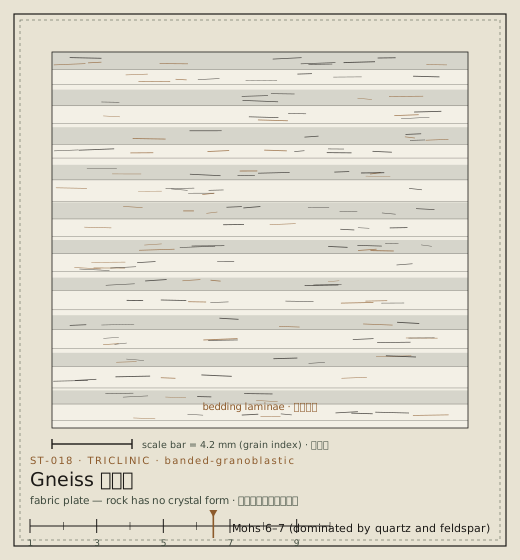
Specimen properties
| Sheet | ST-018 |
|---|---|
| Chemical formula | Quartz + feldspar + biotite or hornblende, segregated into light and dark bands |
| Classification | Metamorphic · high-grade banded变质岩 · 高级条带状 |
| Hardness, Mohs | 6–7 (dominated by quartz and feldspar) |
| Streak | White to pale grey白色至浅灰 |
| Lustre | Vitreous on the light bands, micaceous and shiny on the dark ones浅色条带玻璃光泽,暗色条带云母质闪光 |
| Cleavage | No rock cleavage; the rock splits along the boundary between bands无岩石解理;沿条带界面裂开 |
| Fracture | Breaks across the bands into blocky pieces; unlike schist, it is not fissile横向穿过条带断成块状;与片岩不同,它不易劈开 |
| Colour | Alternating light grey or pink and dark grey or black bands浅灰或粉色与深灰或黑色条带交替 |
| Crystal system | triclinic |
| Crystal habit / fabric | banded-granoblastic · 3-fold · 1 cleavage dir. · twinned |
| Published | 2026-10-10 |
| Byline | By The Specimen Desk |
Related formulae
SiO₂ · KAlSi₃O₈ · NaAlSi₃O₈ · K(Mg,Fe)₃AlSi₃O₁₀(OH)₂
Field tests, in order
Why the bands separate
At high temperature the atoms in a rock become mobile enough for minerals to segregate. Quartz and feldspar, which are light and relatively rigid, recrystallise into continuous light bands; biotite, hornblende and other dark minerals concentrate into their own layers. The process is called metamorphic differentiation, and it produces a rock with strong compositional layering even if the protolith was uniform. The protolith could have been almost anything — granite, shale, volcanic ash, even an older gneiss — which is why geologists name gneisses by their mineral content and prefix: biotite gneiss, hornblende gneiss, augen gneiss for the variety with large eye-shaped feldspars.
Gneiss versus granite, the practical problem
This is the identification that trips up most field workers, because a coarse pink and grey banded rock feels like granite in the hand.
- Look from a distance. Granite shows speckling; gneiss shows bands. If you can see layering at two metres, it is gneiss.
- Trace a single band. Gneiss bands continue across the outcrop; granite's mineral patches do not.
- Check the mica. In granite, biotite flakes sit randomly between grains. In gneiss they lie in connected layers.
- Look for folding. Folded bands mean the fabric predates or accompanied deformation, which only happens in a metamorphic rock.
The oldest rocks on Earth are gneisses
Because gneiss forms at high grade and is relatively resistant to later alteration, it is what survives from the earliest chapters of Earth history. The Acasta Gneiss in the Northwest Territories contains zircon crystals dated to 4.03 billion years, the oldest known terrestrial material. The Lewisian complex of northwest Scotland includes gneisses around 3 billion years old with later intrusions cutting them. In China, the Archaean Taishan gneiss suite of Shandong is the standard reference for the oldest basement in the North China Craton. When you pick up a gneiss you may be holding rock that has been recycled through at least one full mountain-building cycle.
Practical use and field hazards
Gneiss is a decent building stone because it is blocky rather than fissile, and it is widely quarried for aggregate and dimension stone. Its banding is a structural weakness if the bands happen to be aligned so that they dip toward a road cut or a foundation excavation, so engineers treat gneiss as a rock whose engineering properties depend on orientation, much as schist does. In the field, gneiss terrain tends to form rounded, cleared outcrops with a smoother profile than schist — and because it is ancient and deeply weathered in places, saprolite zones can be tens of metres thick and unstable.
Recording a gneiss specimen
Photograph the outcrop before collecting, then record band thickness in centimetres, the mineralogy of both light and dark bands, the orientation of the banding, and whether any folds are present, with their axis direction. If the gneiss contains augen — large eye-shaped feldspars — note their size, because augen gneiss is usually derived from a deformed granite and the eyes preserve evidence of how much strain the rock took.
Sources
Hardness, streak, cleavage and specific-gravity values quoted on this sheet are checked against the references below.
- Geology.com Rocks — rock-type reference — descriptions and photographs of igneous, sedimentary and metamorphic rocks
- National Geographic Society — established educational publisher — encyclopaedic entry on the rock cycle
- British Geological Survey — UK national geological survey — the three rock types, the rock cycle and mineral definitions
Representative localities
Confused with, and how to separate them
Same minerals in similar proportions, but granite has a random mosaic texture and no banding
Schist is defined by mica fabric and is fissile; gneiss is defined by banding and is blocky
Collecting and storage
Gneiss is what makes up much of the deep continental crust, so a good specimen is a sample of rock that has been to 20 or 30 kilometres depth and come back. Take a block large enough to show at least three bands, and record whether the banding is regular or contorted — folded gneiss with tight isoclinal folds records a much more complex history than flat-lying banding. The word is pronounced "nice", and field geologists have been losing that argument for two centuries.
Key points
- Gneiss is defined by centimetre-scale light and dark bands, not by a single mineral.
- Metamorphic differentiation segregates quartz and feldspar from mica and hornblende.
- It is distinguished from granite by visible layering at a distance and by connected mica layers.
- The oldest known terrestrial material, 4.03 billion years old, comes from the Acasta Gneiss.
- Banding orientation controls its engineering behaviour, so record strike and dip with the specimen.