Quartzite
石英岩
Quartzite is what happens to a pure quartz sandstone when it is buried deeply enough that the grains recrystallise and weld together. The cement disappears, the grain boundaries heal, and the rock becomes a single interlocking mass of quartz — harder than the steel you are carrying and completely different in behaviour from the sandstone it came from.
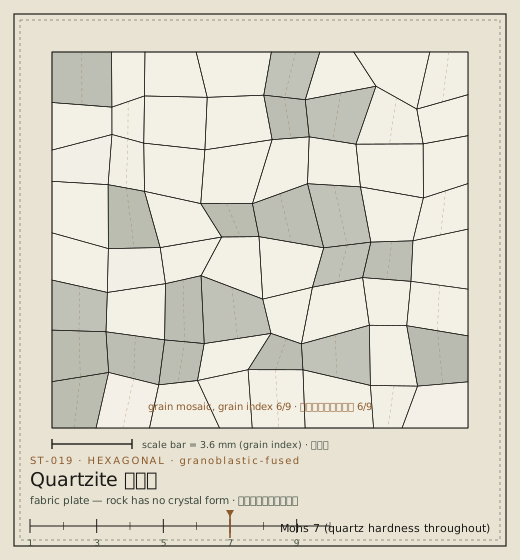
Specimen properties
| Sheet | ST-019 |
|---|---|
| Chemical formula | SiO₂, recrystallised from a quartz sandstone protolith |
| Classification | Metamorphic · non-foliated siliceous变质岩 · 无叶理硅质 |
| Hardness, Mohs | 7 (quartz hardness throughout) |
| Streak | White白色 |
| Lustre | Vitreous to sugary; a fresh surface sparkles in sunlight玻璃至砂糖状光泽;新鲜面在阳光下闪亮 |
| Cleavage | None. The rock is a fused mosaic of quartz grains with no plane of weakness无解理。岩石是石英颗粒熔结成的一体镶嵌体,没有薄弱面 |
| Fracture | Conchoidal to uneven, breaking through grains rather than around them贝壳状至不平坦,穿过颗粒断开而非绕过颗粒 |
| Colour | White, grey, pink, red, purple or brown depending on iron oxide content白、灰、粉、红、紫或褐色,取决于氧化铁含量 |
| Crystal system | hexagonal |
| Crystal habit / fabric | granoblastic-fused · 6-fold · 0 cleavage dir. |
| Published | 2026-10-22 |
| Byline | By The Specimen Desk |
Related formulae
SiO₂ · Fe₂O₃ (as colouring)
Field tests, in order
The welding process
Sandstone is held together by cement between the grains. Quartzite has no cement: at temperatures above roughly 300 degrees Celsius under pressure, silica dissolves at the points where grains touch and reprecipitates in the pore spaces, so the original grains fuse into a continuous mosaic. The distinction is not just academic. In sandstone, a crack propagates along the cement between grains, so the rock breaks around them and you can see individual sand grains on the fracture surface. In quartzite, there is no weak path between grains, so the crack goes straight through them. That single difference in behaviour — breaks through versus breaks around — is the most reliable field test, and it is why quartzite feels and sounds different under a hammer.
Quartzite versus sandstone, in the field
The two can be adjacent in the same sequence, so the boundary is worth being able to find.
| Test | Sandstone | Quartzite |
|---|---|---|
| Fracture surface | Grainy; grains and cement visible | Sugary and sparkling; no cement visible |
| Break a piece | Around grains, leaving loose sand | Through grains, leaving a clean edge |
| Hammer sound | Dull thud, or a weak ring if silica-cemented | Clear high ring |
| Weathering | Crumbly, often with a soft rind | Rounded, smooth, resistant; forms ridges |
| Cross-bedding | Usually visible | Preserved but often smeared and harder to read |
What it tells you about the landscape
Because quartzite resists both chemical weathering and physical abrasion better than almost anything else, it dominates the ridgelines of the areas where it occurs. The Sioux Quartzite forms a ridge across South Dakota, Minnesota and Iowa; the Table Mountain Group quartzite caps the flat summit of Cape Town's signature mountain as well as the surrounding escarpments. Quartzite boulders also travel: they survive river transport better than the surrounding rocks, so they accumulate as resistant cobbles far downstream, and as residual gravel caps on hilltops where everything softer has been stripped away. In Appalachia, quartzite ridge tops that no longer have any source rock uphill are a standard example of this.
Uses and one important caveat
Quartzite is quarried for aggregate, for railway ballast and for dimension stone, and it is a genuinely good material for all three because it is hard, inert and resistant. Higher-grade quartzite is also the feedstock for ferrosilicon and silicon metal, and some very pure quartzites serve as the silica source for glass. The caveat is commercial: much of what is sold as "quartzite" countertop in the building trade is actually a quartz-rich sandstone or a quartz-cemented metasediment, and it stains and etches accordingly. The geological test is the fracture behaviour — real quartzite does not have visible grains on a broken surface.
Collecting and recording
One clean broken block, at least 8 cm, will demonstrate every property you need. Record the colour, whether cross-bedding is visible, the hammer ring, and whether the sequence nearby contains sandstone that has not been metamorphosed. The transition between the two, if you can find it, is more informative than either rock alone: it tells you where the metamorphic front was, and how far the heat penetrated.
Sources
Hardness, streak, cleavage and specific-gravity values quoted on this sheet are checked against the references below.
- Geology.com Rocks — rock-type reference — descriptions and photographs of igneous, sedimentary and metamorphic rocks
- Minerals.net — mineral property database — hardness, specific gravity, cleavage and streak per mineral
- British Geological Survey — UK national geological survey — the three rock types, the rock cycle and mineral definitions
Representative localities
Confused with, and how to separate them
The unmetamorphosed version: sandstone breaks around grains and has visible cement
Both are pale, hard-looking and non-foliated; marble fizzes in acid, quartzite does not
Collecting and storage
Quartzite is one of the toughest common rocks and will dull a geological pick quickly; a sledge and a chisel serve better. Because it resists both chemical weathering and abrasion, quartzite boulders travel far in river systems and end up far from their source, so a stream cobble is a poor guide to local geology. Collect from the outcrop if the provenance matters.
Key points
- Quartzite is recrystallised quartz sandstone with no cement; the grains fuse into one mosaic.
- It breaks through grains while sandstone breaks around them — the most reliable field test.
- It does not fizz in acid (unlike marble) and does not scratch with a knife (unlike limestone).
- Its resistance makes it ridge-forming and long-travelled as river cobbles.
- Much of the commercial "quartzite" stone is not quartzite; test the fracture behaviour.