Marble
大理岩
Marble is limestone that has been cooked. Given enough heat and pressure, calcite grains recrystallise into a dense interlocking mosaic, the fossils and bedding are destroyed, and the rock becomes harder, denser and completely non-foliated — the simplest and most useful metamorphic rock to recognise.
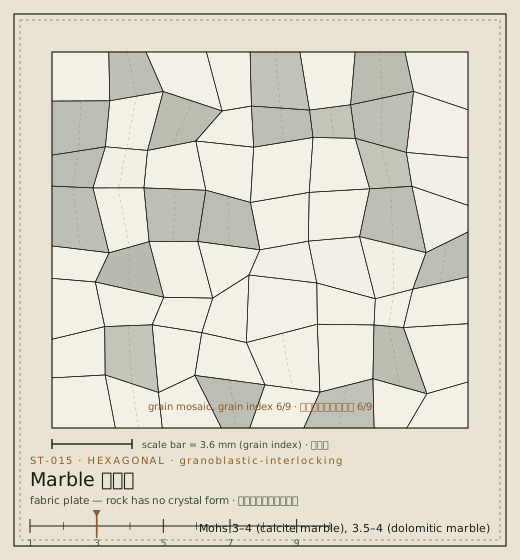
Specimen properties
| Sheet | ST-015 |
|---|---|
| Chemical formula | Recrystallised CaCO₃; dolomitic marble is CaMg(CO₃)₂ |
| Classification | Metamorphic · non-foliated carbonate变质岩 · 无叶理碳酸盐 |
| Hardness, Mohs | 3–4 (calcite marble), 3.5–4 (dolomitic marble) |
| Streak | White白色 |
| Lustre | Vitreous to sugary on a broken face; polished surfaces take a high sheen断口呈玻璃至砂糖状光泽;抛光面光泽很高 |
| Cleavage | Three rhombohedral directions in each calcite grain, but the grains interlock so the rock does not part along them每颗方解石颗粒有三组菱面体解理,但颗粒相互镶嵌,岩石不会沿之裂开 |
| Fracture | Even to uneven, granular; breaks across the grains rather than along a fabric平坦至不平坦,呈粒状;穿过颗粒断开而非沿组构 |
| Colour | White, cream, grey, green, pink or black; often veined or mottled白、米、灰、绿、粉或黑;常带细脉或斑驳 |
| Crystal system | hexagonal |
| Crystal habit / fabric | granoblastic-interlocking · 6-fold · 3 cleavage dir. · twinned |
| Published | 2026-08-28 |
Related formulae
CaCO₃ · CaMg(CO₃)₂ · SiO₂ (as accessory)
Field tests, in order
The recrystallisation step
Protolith, in metamorphic terminology, is the rock you started with. For marble it is almost always a limestone or dolostone. During metamorphism the calcite does not melt — it dissolves and reprecipitates at grain boundaries, and the small grains that made up the fossil fragments and micrite mud coarsen into a uniform mosaic of 0.5 to 3 millimetre crystals. Anything that was not calcite behaves differently: clay impurities react to form mica, quartz, or calcium silicates such as diopside and wollastonite, and those accessory minerals are what give marble its colour banding and mottling. Pure white marble means the protolith was a very pure limestone.
Why marble has no foliation
The key diagnostic point is what marble lacks. Metamorphism normally produces foliation — the alignment of platy minerals into layers — because pressure squeezes mica and chlorite flat. Calcite is not platy in that way. It has rhombohedral cleavage in three directions, so under pressure it recrystallises into equigranular grains rather than aligning into sheets. The result is a rock that looks the same in every direction: no cleavage, no schistosity, no banding except where impurities define it. That is why marble is the standard first example of a non-foliated metamorphic rock, alongside quartzite and hornfels.
Field identification
Three checks settle it, in under two minutes.
- Acid. Drop 10% hydrochloric acid on a broken surface. Vigorous fizzing confirms a carbonate. Dolomitic marble reacts weakly, so powder a little and test again.
- Fossils and bedding. Marble has neither. If you can see intact shells or a clear bedding plane, the rock is still limestone.
- Texture with a lens. Look for 0.5–3 mm calcite grains fitting together like a mosaic with no cement between them.
Where it comes from and what it is used for
Marble forms where limestone is caught in a mountain belt or intruded by a hot body. Carrara sits in the Apuane Alps, where the Apennine orogeny stacked and heated a Jurassic limestone sequence; it has been quarried since Roman times and supplied the stone for Michelangelo's David. Vermont's marble belt is folded and faulted Ordovician and Silurian carbonate. In China, the type locality at Dali in Yunnan gave the rock its Chinese name. Commercially, marble is used for dimension stone, for lime and cement, and for calcium carbonate filler in paper, paint and plastics. Some marbles are also excellent for acid neutralisation, which is why the same rock that dissolves in acid rain is used in scrubbers to remove sulphur dioxide from power station flue gas.
Practical field notes
Two hazards deserve a mention. Marble quarries produce large, unstable block stacks and have blast schedules; never enter one without permission. And marble is a soft rock that wears quickly on paths and stairs, so where you find it in an old building it is usually from a hard variety — a colour clue to the presence of quartz or dolomite in the protolith. For collection, a marble specimen should show the interlocking texture clearly, which usually means breaking a piece rather than picking up a weathered surface sample.
Representative localities
Confused with, and how to separate them
Both are metamorphic and pale, but quartzite does not fizz and is much harder
Limestone is finer and still has bedding and fossils; marble has recrystallised past both
Collecting and storage
Dolomitic marble barely reacts to cold acid, so run the powder test before writing a label. Quarries produce the best specimens; ask permission and stay out of the blasting area. Marble weathers in the open within decades — calcium carbonate dissolves in acid rain and the polished face turns chalky — so any exposed surface you collect is the one you will have to live with.
Key points
- Marble is recrystallised limestone; fossils and bedding are destroyed in the process.
- Calcite's rhombohedral cleavage prevents foliation, so marble is non-foliated.
- Vigorous fizzing plus a granular mosaic texture and no fossils identifies it in the field.
- Colour banding comes from non-carbonate impurities in the original limestone.
- Dolomitic marble reacts weakly to cold acid; use the powder test.