Schist
片岩
Schist is the middle grade of regional metamorphism — hot enough, roughly 400 to 600 degrees Celsius, for mica to grow into flakes you can see and for new minerals to crystallise that carry a record of the pressure and temperature the rock experienced. It is the most information-rich common rock in a mountain belt, and reading it is a skill worth developing.
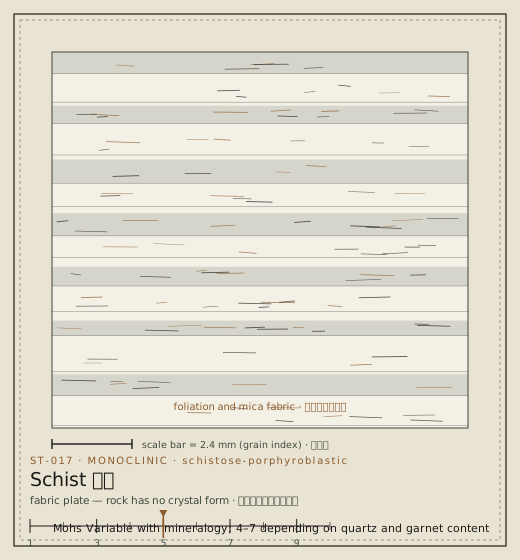
Specimen properties
| Sheet | ST-017 |
|---|---|
| Chemical formula | Variable: muscovite, biotite, chlorite, quartz, feldspar, garnet, staurolite, kyanite |
| Classification | Metamorphic · medium-grade foliated变质岩 · 中级叶理 |
| Hardness, Mohs | Variable with mineralogy; 4–7 depending on quartz and garnet content |
| Streak | White to grey; individual mica flakes leave a colourless streak白色至灰色;单颗云母片留下无色条痕 |
| Lustre | Strongly micaceous and shiny; the schistosity surface glitters云母质强、闪亮;片理面呈闪烁光泽 |
| Cleavage | Perfect basal cleavage in the mica, aligned into a continuous schistosity云母具极完全底面解理,定向排列构成连续片理 |
| Fracture | Splits along the schistosity into irregular wavy sheets; the rock is often crumbly across the fabric沿片理裂成不规则波状薄片;垂直组构方向常易碎 |
| Colour | Silver, grey, green, brown or black; garnet schists show dark red porphyroblasts银、灰、绿、褐或黑色;石榴石片岩具暗红色变斑晶 |
| Crystal system | monoclinic |
| Crystal habit / fabric | schistose-porphyroblastic · 2-fold · 1 cleavage dir. · twinned |
| Published | 2026-09-28 |
| Byline | By The Specimen Desk |
Related formulae
KAl₂(AlSi₃O₁₀)(OH)₂ · K(Mg,Fe)₃AlSi₃O₁₀(OH)₂ · Al₂SiO₅ · Fe₃Al₂(SiO₄)₃
Field tests, in order
Visible mica is the whole definition
The boundary between phyllite and schist is drawn at the point where individual mica flakes become resolvable with a hand lens, around 0.1 to 1 millimetre. Below that the fabric is silky and the rock is phyllite; above it the flakes catch the light separately and the rock is schist. Schistosity is not a flat surface like slaty cleavage — it is a wavy, anastomosing fabric that thickens and thins, wraps around harder grains and often contains several generations of folding. That complexity is the point: schist has been through more than one deformation event in most mountain belts.
Index minerals: a thermometer you can carry
Different minerals grow at different temperature and pressure, so their first appearance in a rock marks a grade boundary. Mapping these boundaries across a region is how metamorphic belts were originally zoned.
| Index mineral | Approximate condition | What it looks like in the field |
|---|---|---|
| Chlorite | 200–350 °C | Green, soft, dull flakes |
| Biotite | 350–450 °C | Black shiny flakes, visible with a lens |
| Garnet (almandine) | 450–550 °C | Red-brown dodecahedra, often 5–15 mm |
| Staurolite | 550–650 °C | Brown prisms, frequently twinned into crosses |
| Kyanite | 600–700 °C, high pressure | Blue-grey blades with a marked hardness difference along the length |
| Sillimanite | 650–750 °C | White fibrous needles, often silky masses |
Porphyroblasts and what they record
A porphyroblast is a large crystal that grew in a finer matrix during metamorphism. Garnet is the classic example because it is hard, chemically resistant and traps inclusions of whatever surrounded it as it grew. Those inclusions make a pattern called a trail: straight trails mean the rock grew steadily without deforming, curved trails mean the garnet rotated or the fabric was folding while it grew, and a trail that bends only near the rim means deformation started late. This is one of the few places in geology where the sequence of events can be read directly from a hand specimen, and it is why garnet schists are collected carefully rather than just for the crystals.
Where you meet it, and what it is used for
Schist belts underlie a surprising amount of the built environment. Manhattan's skyline sits on Cambro-Ordovician schist, which is strong enough to support very heavy foundations provided the schistosity dips the right way — where the fabric dips toward an excavation, slabs can slide and the rock behaves far less well than its strength suggests. Schist is generally too fissile for good dimension stone, so its main uses are as fill and, historically, as flagstone. In the ultrahigh-pressure belts such as Dabie in Anhui and the Western Gneiss Region of Norway, schists contain coesite, which can only form above about 2.5 gigapascals — evidence that continental crust was buried to 90 kilometres and then returned to the surface.
Collecting and field records
Take an oriented specimen with a clear porphyroblast if you can find one; the inclusion trails are the scientific payload and they are destroyed by careless handling. Record the schistosity dip and strike, the direction of any fold axes visible in the outcrop, and the identity of any index minerals. Beware the practical hazard: schist slopes fail along the foliation when it dips toward the slope face, so the mica fabric that makes the rock interesting is also what makes it treacherous to walk on.
Sources
Hardness, streak, cleavage and specific-gravity values quoted on this sheet are checked against the references below.
- Geology.com Rocks — rock-type reference — descriptions and photographs of igneous, sedimentary and metamorphic rocks
- Geology.com Mohs Hardness Scale — reference article by a PhD geologist — Mohs scale, field hardness tests, hardness of common minerals
- Geology.com Mineral Encyclopedia — mineral property database — hardness, cleavage, streak, specific gravity and chemical composition per mineral
Representative localities
Confused with, and how to separate them
Phyllite is lower grade: its mica is too fine to resolve and its surface is crinkled rather than flaky
Gneiss has the same minerals but segregated into light and dark bands rather than a single continuous mica fabric
Collecting and storage
Schist weathers badly in a collection because the mica fabric lets water in along every band, so specimens flake apart after a few freeze-thaw cycles. Wrap them and keep them dry. Garnet-bearing schist is the most sought-after variety — look for the garnets on a weathered surface, where they stand proud because the surrounding mica has been washed away, then extract one intact from the fresh rock rather than picking the loose crystals off the surface.
Key points
- Visible mica flakes define schist and separate it from phyllite and slate.
- Index minerals such as biotite, garnet, staurolite and kyanite record metamorphic grade.
- Garnet inclusion trails preserve the sequence of growth and deformation events.
- Schist is weak along its foliation — a foundation and slope-stability concern, not just a field observation.
- UHP schists containing coesite prove crustal burial to around 90 km.