Granite
花岗岩
Granite is the rock most people name correctly and describe least accurately. It is the coarse, light-toned intrusive rock built from quartz, alkali feldspar and a little mica — but the identification that survives scrutiny comes from texture, grain size and the proportion of dark minerals, not from the word on the label.
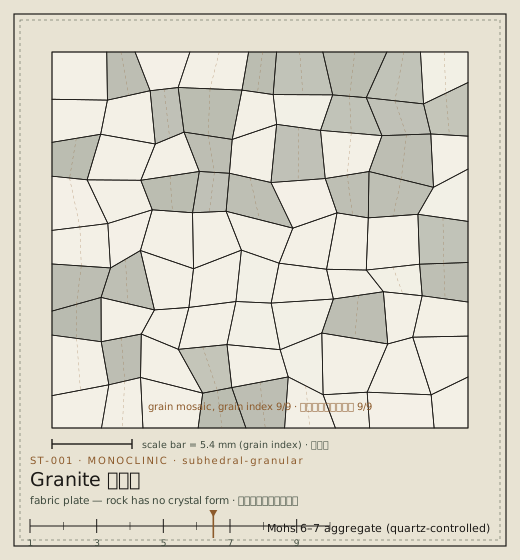
Specimen properties
| Sheet | ST-001 |
|---|---|
| Chemical formula | Quartz SiO₂ + alkali feldspar (KAlSi₃O₈) + plagioclase + mica |
| Classification | Plutonic · felsic深成岩 · 长英质 |
| Hardness, Mohs | 6–7 aggregate (quartz-controlled) |
| Streak | White; the feldspar leaves a dull white powder on unglazed tile白色;长石在无釉瓷板上留下暗白色粉末 |
| Lustre | Vitreous on fresh quartz, pearly on mica, dull on weathered feldspar新鲜石英玻璃光泽,云母珍珠光泽,风化长石土状光泽 |
| Cleavage | None in quartz; mica peels in one perfect direction; feldspar shows two at 90°石英无解理;云母一组极完全解理可剥离;长石两组近直角解理 |
| Fracture | Conchoidal in quartz, uneven across the feldspar石英呈贝壳状,长石呈不平坦状 |
| Colour | Grey, pink, or white groundmass with black or silver speckles灰、粉或白色基底,夹黑或银色斑点 |
| Crystal system | monoclinic |
| Crystal habit / fabric | subhedral-granular · 5-fold · 2 cleavage dir. · twinned |
| Published | 2026-08-19 |
Related formulae
SiO₂ · KAlSi₃O₈ · NaAlSi₃O₈ · K(Mg,Fe)₃AlSi₃O₁₀(OH)₂
Field tests, in order
What you are actually holding
Granite crystallised slowly, several kilometres down, in a magma body that lost heat over tens of thousands of years. Slow cooling is the whole story of its appearance: crystals had time to grow to 3–10 mm and to interlock, so the rock has no preferred direction of break and no visible cement. Every grain touches its neighbours directly. Press a hand lens to a fresh surface and you should see three things at once — glassy translucent quartz, opaque blocky feldspar, and thin shiny flakes of mica wedged into the gaps.
The three-second check
Before you take a single measurement, sort the rock by eye. Two numbers decide the name.
- Grain size: can you see individual crystals without a lens? If yes, the rock is coarse-grained and plutonic. If the grains need a lens, it is fine-grained and probably volcanic.
- Dark-mineral content: sweep your eye across one face and estimate the fraction of black or dark green grains. Under 15% is granitic; 15–40% is granodiorite or diorite country.
- Feldspar colour: pink or cream feldspar with a lot of quartz reads as granite. White feldspar with less quartz reads as granodiorite.
Hardness and how to test it without a kit
Granite does not have a Mohs number of its own — it is a mosaic, and the file bites the softest mineral first. In practice the knife test is diagnostic because the two feldspars behave differently from quartz.
| Tool | Effect on granite | What it proves |
|---|---|---|
| Fingernail (2.5) | No mark | Nothing useful — expected |
| Copper coin (3.5) | No mark | Rules out calcite and gypsum veins |
| Steel knife (5.5) | Bites the mica, glances off feldspar | Mica confirmed; not a carbonate rock |
| Quartz (7) scratch | Quartz scratches feldspar but not the reverse | Separates the two pale minerals |
Where granite sits in the landscape
Granite forms the bones of continents and it behaves accordingly at the surface. It is jointed rather than layered, so it weathers into rounded tors, exfoliation domes and rectangular blocks instead of the slabby ledges you get in sedimentary country. Joint spacing controls the landform: wide joints produce the huge clean faces of Yosemite and Dartmoor, tight joints produce gravel-sized grus. Streams crossing granite are usually clear and slightly acidic, and the thin soils above them are poor in calcium — a good field hint long before you reach the outcrop.
Recording the specimen
A granite specimen without its context is nearly worthless in a collection, because every one of the fields above depends on where it came from.
- Photograph the outcrop in place, with the hammer or a coin for scale, before you break anything.
- Record GPS or a grid reference plus the joint orientation if the exposure shows one dominant set.
- Note the weathering state: fresh grey, iron-stained, kaolinised (the feldspar turns chalky white), or grussified.
- Label with number, date and locality on a slip inside the bag, then transfer the same data into your notebook the same evening.
Representative localities
Confused with, and how to separate them
Darker, plagioclase-dominated, and much easier to confuse in weathered hand specimens
Has the same minerals but a fabric: the feldspar and mica lie in bands instead of an interlocking mosaic
Collecting and storage
Leave coastal and protected-area exposures alone. A 6 × 6 × 4 cm piece is enough for hardness, acid and streak work; anything larger just makes the pack heavier. Wet and wrap it, because feldspar grains abrade each other and turn a careful specimen into a bag of sand.
Key points
- Granite is defined by coarse interlocking texture plus quartz and alkali feldspar, not by pink colour.
- Under 15% dark minerals and greater than 20% quartz is the practical field rule.
- The knife test separates mica from feldspar; the quartz scratch test separates feldspar from quartz.
- Joint-controlled landforms — tors and domes — are the landscape signature of granite country.
- Record locality, weathering and joint orientation; a specimen without context loses most of its value.