Dolomite (dolostone)
白云岩
Dolostone looks like limestone, breaks like limestone and is used like limestone, but a drop of acid gives it away — or rather, fails to. Its mineral, dolomite, is calcium magnesium carbonate, and the magnesium locks the crystal lattice so tightly that cold weak acid barely touches it.
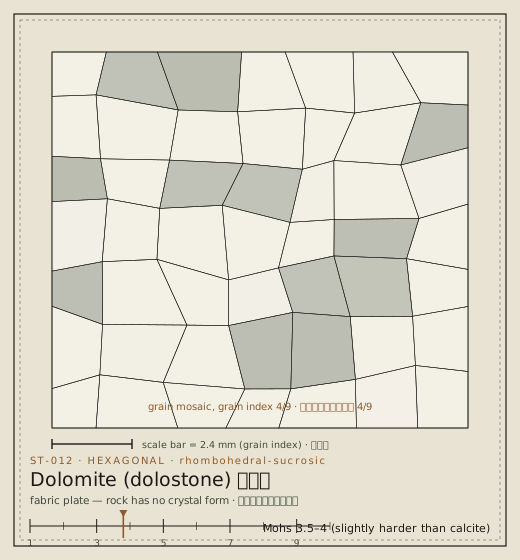
Specimen properties
| Sheet | ST-012 |
|---|---|
| Chemical formula | CaMg(CO₃)₂ — strictly the mineral is dolomite, the rock is dolostone |
| Classification | Chemical · carbonate (rock name: dolostone)化学岩 · 碳酸盐(岩石名:白云岩) |
| Hardness, Mohs | 3.5–4 (slightly harder than calcite) |
| Streak | White to pale grey白色至浅灰 |
| Lustre | Dull to vitreous; sugary on weathered surfaces暗淡至玻璃光泽;风化面上呈砂糖状 |
| Cleavage | Three perfect directions in the rhombs, at 74° — slightly steeper than calcite菱面体三组完全解理,夹角约 74°,比方解石略陡 |
| Fracture | Uneven to subconchoidal; the rock is tough and hard to break cleanly不平坦至亚贝壳状;岩石坚韧,不易干净断开 |
| Colour | Grey, cream, buff, pinkish or brown, often with a weathered buff crust灰、米、米黄、粉或褐色,常覆米黄色风化壳 |
| Crystal system | hexagonal |
| Crystal habit / fabric | rhombohedral-sucrosic · 6-fold · 3 cleavage dir. · twinned |
| Published | 2026-10-19 |
| Byline | By The Specimen Desk |
Related formulae
CaMg(CO₃)₂ · CaCO₃
Field tests, in order
The acid test, done properly
Standard practice is two tests, not one. First put a drop of 10% hydrochloric acid on a fresh surface. On limestone the reaction is immediate and loud; on dolostone there is either nothing visible or a few slow, sparse bubbles that take ten seconds or more to appear. Then scratch a little powder onto a clean surface and put acid on the powder. Dolomite powder fizzes readily because the reaction rate depends on surface area, and the powder removes that obstacle. A rock that fails the first test and passes the second is dolostone.
Naming: mineral versus rock
There is a naming convention worth getting right, because published descriptions follow it inconsistently. Dolomite is the mineral, CaMg(CO₃)₂ (per Geology.com Mineral Encyclopedia). Dolostone is the rock made mostly of it. Many papers and most field guides use "dolomite" for both, which creates real confusion when a rock is described as "dolomitic limestone" — that phrase means a limestone with 10 to 50 percent dolomite, and it is a distinct and very common category in its own right.
Where the magnesium comes from
This is the part geologists still argue about. Dolomite is rare in modern sediments and abundant in ancient ones, which is the "dolomite problem": seawater is supersaturated with respect to dolomite, yet it barely precipitates today. The working explanation is that most dolostone is secondary — limestone that was altered after deposition by magnesium-bearing fluids, either seawater concentrated by evaporation on a tidal flat, or brines circulating through the rock during deep burial. The field evidence for this is that dolostone bodies usually cut across the original bedding, replacing limestone along particular horizons or along fracture networks rather than forming neat primary layers.
Reading dolostone in the field
Field recognition goes beyond the acid bottle.
- Weathering texture: dolostone develops a distinctive sugary or sandy surface as the softer parts dissolve and the rhombs stand proud.
- Colour: often a warmer buff or cream than the grey of an adjacent limestone, and frequently with a yellowish or orange weathering crust.
- Hardness: a copper coin scratches limestone easily and dolostone only with pressure; a knife scratches both but grooves deeper in limestone.
- Associated minerals: look for small white saddle-shaped rhombs, and for galena, sphalerite or pyrite veins in the Mississippi-Valley-type districts.
Practical consequences
The slow dissolution rate has two visible outcomes. Dolostone makes better aggregate and dimension stone than limestone, and it forms resistant caprocks — the Niagara Escarpment exists because a Silurian dolostone layer outlasts everything around it. In karst regions, dolostone produces a different landform suite from limestone: fewer caves and towers, more broad pavements and rounded ridges, because the dissolution is slower and less selective. If you are mapping a carbonate sequence, the limestone-dolostone boundary is usually also the boundary between two different styles of landscape.
Sources
Hardness, streak, cleavage and specific-gravity values quoted on this sheet are checked against the references below.
- Geology.com Mineral Encyclopedia — mineral property database — hardness, cleavage, streak, specific gravity and chemical composition per mineral
- Geology.com Rocks — rock-type reference — descriptions and photographs of igneous, sedimentary and metamorphic rocks
- National Park Service — U.S. National Park Service geology pages — mineral definition, physical properties and common minerals
Representative localities
Confused with, and how to separate them
Visually identical in many cases; the acid reaction and the slightly higher hardness are the only reliable separators
Marble is a metamorphic carbonate and can be dolomitic too; look for a crystalline fabric and a lack of bedding
Collecting and storage
Dolostone is a better building stone than limestone because it dissolves more slowly, which is why it caps the Niagara Escarpment and provides most of the durable carbonate aggregate in the Great Lakes region. It is also the classic host for Mississippi-Valley-type lead-zinc deposits, so a dolostone outcrop with galena or sphalerite veins is worth recording rather than hammering at. Take both a fresh and a weathered piece: the sugary weathering texture is easy to see in the field and almost impossible to photograph convincingly later.
Key points
- Dolostone barely reacts to cold dilute acid; the powder test confirms it.
- Dolomite is the mineral, dolostone the rock; "dolomitic limestone" is a separate 10–50% category.
- Most dolostone is secondary, formed by magnesium-bearing fluids altering limestone after deposition.
- The sugary weathering texture and a warmer buff colour are the best field clues.
- Slow dissolution produces resistant caprocks and a distinct karst style with fewer caves and towers.