Sandstone
砂岩
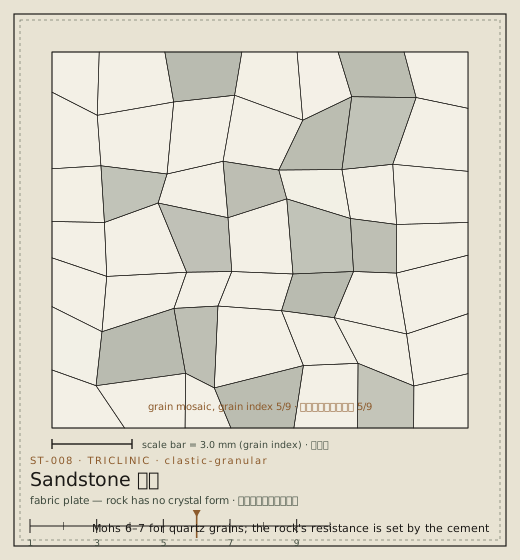
Sandstone is a photograph of a current. Every grain in it was moved by water or wind, and three measurements taken in the field — grain size, sorting and roundness — tell you how far it travelled and how energetic the flow was. The cement that holds it together then tells you what happened afterwards.
Specimen properties
| Sheet | ST-008 |
|---|---|
| Chemical formula | Quartz grains (SiO₂) with a cement of silica, calcite, iron oxide or clay |
| Classification | Clastic · arenite碎屑岩 · 砂岩类 |
| Hardness, Mohs | 6–7 for quartz grains; the rock's resistance is set by the cement |
| Streak | White to pale buff; iron-cemented varieties give a faint reddish powder白色至浅米色;铁质胶结的变种留下浅红色粉末 |
| Lustre | Dull to slightly sugary; grains sparkle under a lens in sunlight暗淡至微砂糖状;阳光下放大镜下颗粒有闪光 |
| Cleavage | None mineralogically, but the rock splits along bedding planes矿物学上无解理,但岩石沿层面剥开 |
| Fracture | Breaks around grains; friable in weakly cemented varieties沿颗粒边缘断开;胶结弱时易散碎 |
| Colour | Buff, grey, red, brown or white depending on the cement米黄、灰、红、褐或白色,取决于胶结物 |
| Crystal system | triclinic |
| Crystal habit / fabric | clastic-granular · 3-fold · 0 cleavage dir. |
| Published | 2026-08-25 |
Related formulae
SiO₂ · CaCO₃ · Fe₂O₃·nH₂O
Field tests, in order
Grain size, sorting and roundness
Grain size is measured on the Wentworth scale, and for field purposes the useful divisions are coarse (1–2 mm), medium (0.25–0.5 mm) and fine (0.125–0.25 mm). Sorting describes how uniform the grains are; roundness describes how much of the original angular shape has been worn off. The three properties move together. A beach sand is well sorted and well rounded because waves have reworked it for thousands of years. A river sand is moderately sorted and sub-angular. A debris flow deposit is badly sorted and angular, because the grains were never separated from each other.
What the cement tells you
Sand becomes sandstone through one of four cements, and which one is present controls how the rock behaves in the field.
| Cement | Field clue | Consequence |
|---|---|---|
| Silica (SiO₂) | Rings under the hammer; grains fracture rather than pull out | Hardest and most durable; forms ridges and sea cliffs |
| Calcite (CaCO₃) | Fizzes in dilute acid | Dissolves in acid rain; weathers to hollows and caves |
| Iron oxide | Red, yellow or brown colour; often a ring pattern | Cement is weak; rock crumbles at the surface |
| Clay matrix | Dull, earthy, soft enough to scratch with a fingernail in bad cases | Friable; slumps and erodes quickly |
Cross-bedding and palaeocurrents
Large sandstone formations are almost never uniform blocks; they are stacks of inclined sets. Each set was a migrating bedform — a dune, a sand wave, a bar — and the direction the foresets dip is the direction the current was moving. A single measurement tells you little. Twenty measurements across an outcrop give you a distribution, and that distribution distinguishes a river system (wide scatter, one dominant direction) from a tidal setting (bimodal, reversing) or an aeolian dune field (very consistent, often with steep foresets around 25–30°). This is real work that you can do with a compass clinometer, a notebook and one afternoon.
Sandstone in the landscape
Because it is bedded and often jointed, sandstone produces landscapes that look nothing like granite country: plateaux capped by resistant beds, deep slot canyons cut along joints, and stepped escarpments where soft and hard layers alternate. The Navajo Sandstone of the Colorado Plateau is the classic example — 600 metres of stacked desert dunes, now a single massive aquifer and the raw material of Zion's and Arches' scenery. Where the cement is silica and the rock is well jointed, sandstone also becomes a climbing destination, which is a useful reminder that the same property that makes a rock durable in geology makes it durable under a cam.
Collecting and recording
Take a block large enough to show the bedding at full scale — 10 cm minimum, ideally oriented. Mark the top surface with a pencil arrow and record the dip direction before you remove it, because on a loose block the orientation is already lost. Note whether the specimen fizzes, whether it rings, and the grain size estimate. Those four data points take two minutes in the field and cannot be recovered later.
Representative localities
Confused with, and how to separate them
The metamorphic version: quartzite breaks through the grains rather than around them
Chert is microcrystalline and has no visible grains at all
Collecting and storage
Sandstone crumbles if it is stored loose with harder rocks, so wrap specimens individually. The interesting information is in the bedding, not the block: photograph the cross-bedding, note the foreset dip direction and measure the set thickness before you take a sample. A sandstone specimen with no orientation data cannot be used to reconstruct the current that deposited it.
Key points
- Grain size, sorting and roundness together indicate transport distance and flow energy.
- The cement determines durability: silica sandstone forms ridges, calcite sandstone weathers into hollows.
- Foreset dip directions measured across an outcrop reconstruct palaeocurrents.
- Sandstone landscapes are bedded and jointed — plateaux, slot canyons and stepped escarpments.
- Record orientation, reaction to acid, hammer ring and grain size before the block leaves the outcrop.