Chert
燧石
Chert is a sedimentary rock made of quartz so fine that no individual crystal can be seen at any useful magnification, and that fineness gives it two properties that changed human history: it fractures along smooth curved surfaces, and it takes an edge sharper than steel. Flint is chert that formed as nodules in chalk; the name is cultural, not chemical.
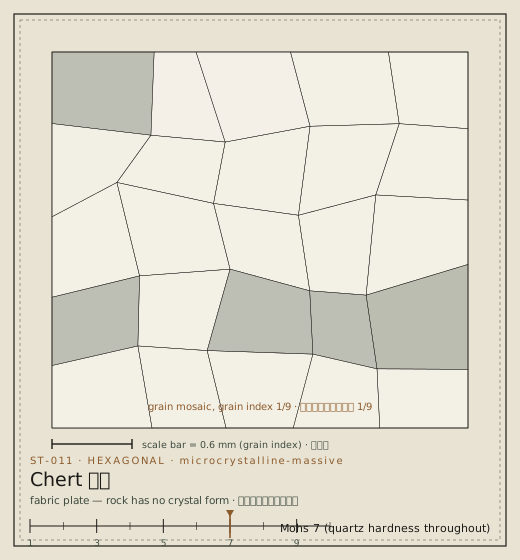
Specimen properties
| Sheet | ST-011 |
|---|---|
| Chemical formula | SiO₂ as microcrystalline quartz and chalcedony, with minor opal |
| Classification | Biochemical/chemical · siliceous生物化学/化学岩 · 硅质 |
| Hardness, Mohs | 7 (quartz hardness throughout) |
| Streak | White to very pale grey; hard to raise at all白色至极浅灰;很难留下条痕 |
| Lustre | Waxy to dull on weathered surfaces, vitreous on fresh breaks风化面蜡状至土状;新鲜断面玻璃光泽 |
| Cleavage | None; the rock is a microcrystalline mosaic with no preferred break无解理;岩石为隐晶质镶嵌体,无方向性破裂面 |
| Fracture | Smooth conchoidal with sharp edges — the basis of its use for tools光滑的贝壳状断口,边缘锋利——这正是它被用作工具的原因 |
| Colour | Grey, white, black, brown, red or green; often banded or nodular灰、白、黑、褐、红或绿;常呈条带状或结核状 |
| Crystal system | hexagonal |
| Crystal habit / fabric | microcrystalline-massive · 6-fold · 0 cleavage dir. |
| Published | 2026-10-07 |
| Byline | By The Specimen Desk |
Related formulae
SiO₂ · SiO₂·nH₂O (opal)
Field tests, in order
Microcrystalline quartz, and why the fineness matters
Chert is built of quartz crystals mostly under 30 micrometres across, often much smaller, plus chalcedony and sometimes opal. Because the crystals are too small to deflect a propagating crack, a fracture runs straight through the rock in a smooth curved sheet rather than being scattered by grain boundaries. This is what a knapper exploits: strike the right angle and you control where the crack goes, which is impossible in a coarse rock like granite. The same property makes chert treacherous in the field — a flake edge is a blade.
Where it comes from
Chert forms by several routes, and in the field you can often tell which one produced the rock in your hand.
| Occurrence | Field appearance | Origin |
|---|---|---|
| Nodular flint in chalk | Irregular blobs and bands following the bedding, with a white outer cortex | Silica dissolved from sponge spicules and diatoms, reprecipitated in the sediment |
| Bedded chert | Continuous tabular beds, often red or green, interleaved with shale | Accumulation of radiolarian and diatom skeletons on a deep sea floor |
| Nodules in limestone | Discrete lumps with sharp contact against the host limestone | Silica mobilised during burial and concentrated at particular horizons |
| Replacement chert | Preserves the texture of the rock it replaced, including fossils | Silica replacing carbonate minerals molecule by molecule |
Flint, the material of prehistory
In Europe, flint nodules from chalk were the primary tool material for hundreds of thousands of years. The reason is practical: chalk erodes quickly, releasing nodules onto beaches where they lie loose and can be picked up without mining, and the flint inside is fresh and glassy while the outer cortex protects it. Flint Ridge in Ohio was quarried so intensively that the pits are still visible after twelve thousand years. If you find worked flakes, note the position and orientation and leave them in place — most jurisdictions protect archaeological material regardless of the land's ownership.
Chert in the landscape and in the economy
Chert resists weathering far better than the limestone or chalk it commonly sits in, so it concentrates as residual gravel on hilltops, in river gravels and on beaches long after the host rock has dissolved away. That resistant quality made it useful for road metal in the past. Bedded cherts, meanwhile, are the primary source rock for a large share of California's oil, because the microscopic organisms that built them were also rich in organic carbon. Recognising chert in a field area therefore has a practical payoff beyond identification: it tells you the host sequence was deposited in a deep-water or high-productivity setting.
Testing and recording
The two-minute field test is scratch and acid: chert does not scratch with a knife and does not fizz. Record whether it is nodular, bedded or replacing something, the colour of the fresh break, and whether a cortex is present. Store separately from softer rocks, since a chert flake in a box of shale will grind it to powder.
Sources
Hardness, streak, cleavage and specific-gravity values quoted on this sheet are checked against the references below.
- Geology.com Rocks — rock-type reference — descriptions and photographs of igneous, sedimentary and metamorphic rocks
- Geology.com Mineral Encyclopedia — mineral property database — hardness, cleavage, streak, specific gravity and chemical composition per mineral
- Minerals.net — mineral property database — hardness, specific gravity, cleavage and streak per mineral
Representative localities
Confused with, and how to separate them
Similar fracture and translucency, but obsidian is volcanic glass with a hydration history and often a jet-black colour
Quartzite is a metamorphic rock of fused quartz grains and usually shows a faint granular texture and lighter colours
Collecting and storage
Chert edges cut like glass, so carry it wrapped. Flint nodules in chalk are best extracted from loose beach material rather than chiselled out of a cliff face — coastal chalk cliffs are unstable and the nodules are eroding free anyway. The archaeologically important localities, such as Flint Ridge, have collecting limits; worked flakes and tools are usually protected regardless of where they are found.
Key points
- Chert is microcrystalline quartz; the crystal size is what produces the conchoidal fracture.
- Flint is simply chert that formed as nodules in chalk — a cultural rather than chemical distinction.
- The knife-and-acid test separates it from limestone (fizzes) and from softer rocks (scratches).
- Bedded chert is a major deep-water source rock; nodular flint is a prehistoric tool resource.
- Chert survives when its host rock dissolves, so it concentrates in residual gravels and beach shingle.