Pumice
浮岩
Pumice is the only common rock that reliably floats on water, and the reason is simple arithmetic: 60 to 85 percent of its volume is gas. It is a volcanic glass foam, quenched so violently by expanding gas that it froze as a solid before the bubbles could escape.
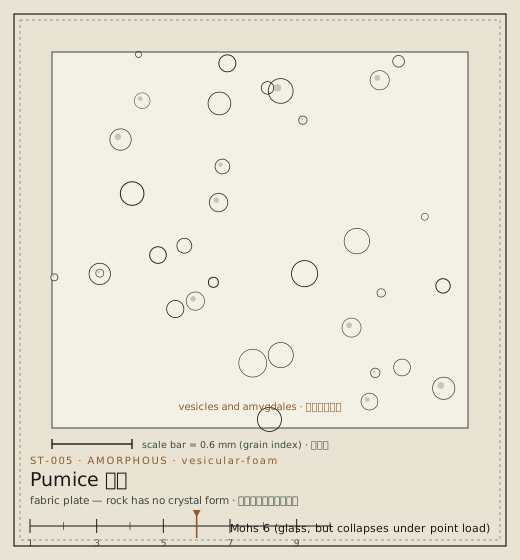
Specimen properties
| Sheet | ST-005 |
|---|---|
| Chemical formula | Amorphous SiO₂-rich glass with 60–85 vol% vesicles; SiO₂ about 65–75 wt% |
| Classification | Volcanic · pyroclastic glass foam火山岩 · 火山碎屑泡沫玻璃 |
| Hardness, Mohs | 6 (glass, but collapses under point load) |
| Streak | White powder, faint白色粉末,浅淡 |
| Lustre | Dull to earthy on the foam surface; vitreous on the thin glass walls between vesicles泡沫表面土状光泽;气孔间玻璃薄壁上呈玻璃光泽 |
| Cleavage | None — it is glass. Vesicle walls break rather than cleave无解理——玻璃质。气孔壁是断开而非解理 |
| Fracture | Uneven, crumbling; individual walls break conchoidally at microscope scale不平坦且易碎;单个气孔壁在显微尺度上呈贝壳状 |
| Colour | White, cream, pale grey; darker grey when wet or when the glass is more iron-rich白、米、浅灰;湿润或玻璃含铁较高时呈较深的灰 |
| Crystal system | amorphous |
| Crystal habit / fabric | vesicular-foam · 0-fold · 0 cleavage dir. |
| Published | 2026-10-16 |
| Byline | By The Specimen Desk |
Related formulae
SiO₂ (amorphous) · Al₂O₃ · K₂O + Na₂O
Field tests, in order
Foam formed in seconds
A pumice clast spends its entire formation history in a violent decompression. When a silica-rich magma reaches the surface, dissolved water — typically 3 to 6 weight percent — exsolves explosively. The melt is torn into droplets, each droplet expands to many times its original volume in a fraction of a second, and the glass transition temperature is crossed before the walls can thin out and merge. What lands is a glass sponge whose solid material occupies a small fraction of the total, and whose density can fall below 0.5 g/cm³ — below water.
Reading the foam
The vesicle structure carries most of the field information.
| Feature | What it tells you |
|---|---|
| Rounded, similar-sized vesicles | Slow, even expansion in a stalled column or dome |
| Elongated tube vesicles | Shear — either flow along the ground or stretching in the eruption jet |
| Very large ragged vesicles | Coalescence, meaning the foam was still hot and deforming when it landed |
| High crystal content | Cooler, more evolved magma; the crystals acted as bubble nucleation sites |
The fall unit matters more than the clast
A pumice fall deposit is stratified, and the layers are not decorative. The coarsest, densest clasts land near the vent; finer material travels further because smaller clasts have more drag per unit mass. A single layer, traced over hundreds of metres, gets thinner and finer with distance — which is how volcanologists estimate column height and reconstruct wind direction at the time of eruption. If you are logging a section, measure layer thickness every ten metres across the outcrop rather than collecting one handsome piece from the middle.
Floating rafts and long voyages
Because it floats, pumice travels. After the 2021 Fukutoku-Okanoba eruption near Japan, rafts of pumice drifted thousands of kilometres west and clogged harbours in Okinawa and eventually reached Taiwan. Earlier submarine eruptions around the Tonga arc produced rafts measured in tens of thousands of square kilometres. Rafts are colonised by marine organisms within weeks, and this is now recognised as a genuine dispersal route for barnacles and corals. If you find pumice on a beach far from any volcano, its composition and its encrusting fauna together tell you which eruption it came from.
Practical handling
Pumice is abrasive and crushable, and both properties show up quickly in the field. It wears through pack fabric and ruins camera lenses if it is sitting loose. It will not survive a rucksack full of harder rock, so carry it on top. Volcanic ash and fine pumice dust are respiratory irritants — in an active eruption area a P2 mask is not excessive. Where pumice is mined commercially, whole hills are removed, so check access rules before collecting on an industrialised deposit.
Sources
Hardness, streak, cleavage and specific-gravity values quoted on this sheet are checked against the references below.
- Geology.com Rocks — rock-type reference — descriptions and photographs of igneous, sedimentary and metamorphic rocks
- British Geological Survey — UK national geological survey — the three rock types, the rock cycle and mineral definitions
Representative localities
Confused with, and how to separate them
Chemically the same glass; pumice is simply the foam version with an order of magnitude more gas
Both are pale and can be lightweight-looking, but chert sinks and has a smooth conchoidal fracture
Collecting and storage
Pumice is a physical record of a single eruption's gas content, so collect a range of clast sizes from one fall unit rather than one big lump. Bag it dry — it crushes under any real load and a rucksack full of pumice becomes powder. If you find a raft of floating pumice on a beach, note the date and the wind direction; these strandings are how long-distance dispersal events are tracked.
Key points
- Pumice floats because 60–85% of its volume is gas trapped in glass.
- It is the foam equivalent of obsidian: same glass, far more gas, faster quench.
- Vesicle shape records flow, shear and coalescence during the eruption.
- Fall deposits fine and thin away from the vent, which is how column height is reconstructed.
- Pumice rafts disperse organisms across ocean basins, so beach strandings are worth documenting.