Obsidian
黑曜岩
Obsidian is the geological exception that proves the rule about igneous rocks: it is an igneous rock that contains no minerals in the strict sense, because it cooled so fast that its atoms never arranged themselves into a lattice. The result is glass — brittle, translucent in thin flakes, and sharp enough that Stone Age people built tool industries around it.
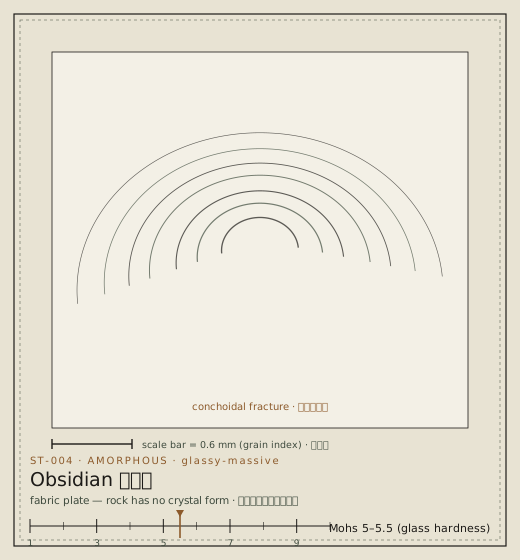
Specimen properties
| Sheet | ST-004 |
|---|---|
| Chemical formula | Amorphous SiO₂-rich glass, roughly 70–77 wt% SiO₂, with 1–3 wt% water |
| Classification | Volcanic glass · felsic to intermediate火山玻璃 · 长英质至中酸性 |
| Hardness, Mohs | 5–5.5 (glass hardness) |
| Streak | White when powdered; a solid piece gives no streak at all粉末为白色;整块标本完全不留条痕 |
| Lustre | Bright vitreous to submetallic; the freshest surfaces look like black bottle glass强玻璃光泽至半金属光泽;最新鲜的面像黑色瓶玻璃 |
| Cleavage | None. Being glass, it has no crystal lattice to cleave along无解理。作为玻璃质,它没有可供解理的晶格 |
| Fracture | Perfectly conchoidal, with ripple marks and razor edges极典型的贝壳状断口,带波纹与刀锋状边缘 |
| Colour | Black, brown-black, or banded; rarely green or blue-black黑色、棕黑或条带状;少见绿或蓝黑色 |
| Crystal system | amorphous |
| Crystal habit / fabric | glassy-massive · 0-fold · 0 cleavage dir. |
| Published | 2026-09-22 |
| Byline | By The Specimen Desk |
Related formulae
SiO₂ (amorphous) · H₂O (structural)
Field tests, in order
How a rock can be a glass
Cooling rate, again, decides everything. Basalt erupting into air loses heat fast but still manages crystals under a millimetre. Rhyolitic magma with a high silica content is far more viscous and conducts heat slowly, so a thin flow or a lava dome margin can drop through the crystallisation window in hours. The melt's atoms lock into place without ordering, and the rock that results behaves like a supercooled liquid rather than a crystalline solid. That is why obsidian shows a conchoidal fracture: there are no planes of weakness to follow, so a crack propagates in a smooth curved sheet.
Recognising it in three moves
Obsidian is one of the few rocks you can identify from across a stream, but the field checks are worth doing properly.
- Look for the fracture. Circular ripple marks radiating from an impact point are visible on almost every fresh surface.
- Check the translucency. Hold a flake edge to the sun; under a millimetre thick, obsidian goes smoky grey-brown.
- Confirm there is no granularity. Even at 10× magnification the surface is smooth — no green specks, no white laths, nothing.
Banding, flow and the colour variants
Rarely is obsidian uniform black. Flow banding — alternating black and brown-grey streaks — records the shearing of viscous lava as it moved, and it is usually parallel to the old flow direction. Mahogany obsidian has red-brown iron oxide streaking; snowflake obsidian contains white radial clusters of cristobalite that grow during slow devitrification; rainbow obsidian owes its sheen to nanometre-scale layers trapping thin-film interference, the same effect that colours a soap bubble. All of these are the same glass with different impurities and cooling histories.
The devitrification clock
Obsidian is metastable. Left alone, glass slowly reorders into tiny crystals — feldspar, cristobalite, quartz — a process called devitrification, and the grey speckled rims on old specimens show it happening. Perlitisation follows, when hydration fractures the glass into onion-like concentric shells. Both processes are time- and temperature-dependent, which is why obsidian from a 20-million-year-old field is grey and dull, while a Hawaiian flow a few centuries old is still jet black and glassy. If you are collecting, this is the feature to record: rim thickness and the proportion of grey devitrified material give you a rough relative age at a glance.
Where it survives in the record
Obsidian does not last. It is chemically reactive, hydrates steadily, and turns into clay in wet tropical climates within a few hundred thousand years. That is why obsidian sources are almost always geologically young — Quaternary or late Tertiary — and why an obsidian artefact found far from any volcano is evidence of trade, not of local eruption. Lipari glass travelled across Neolithic Europe; Yellowstone obsidian moved across the Great Plains. As a field collector you should note the locality precisely, because chemically fingerprinting a piece of archaeological obsidian starts with knowing which flows were available within walking distance.
Sources
Hardness, streak, cleavage and specific-gravity values quoted on this sheet are checked against the references below.
- Geology.com Rocks — rock-type reference — descriptions and photographs of igneous, sedimentary and metamorphic rocks
- British Geological Survey — UK national geological survey — the three rock types, the rock cycle and mineral definitions
Representative localities
Confused with, and how to separate them
Both are dark and can look smooth, but basalt is crystalline and will not show conchoidal ripple marks
Chert has a similar fracture but is lighter, mostly grey to black-brown, and much softer in the hand
Collecting and storage
Obsidian edges are sharper than surgical steel and cut without warning. Carry it wrapped, never loose in a pocket, and do not let children handle raw flakes. Worth knowing: fresh glass hydrates at a measurable rate as water diffuses inward from the surface, so a specimen is a clock — a rim of 1 micrometre corresponds to roughly 600 years of exposure. Collecting from a protected archaeological source site, such as Obsidian Cliff, is prohibited.
Key points
- Obsidian is a supercooled liquid, not a crystalline rock — it has no cleavage and no grains.
- The conchoidal fracture with percussion ripples is the fastest field identification.
- Translucency appears only at flake edges thinner than about a millimetre.
- Grey speckled rims record devitrification, and their thickness is a rough relative age indicator.
- Obsidian is young rock only; anything older has devitrified or turned to clay.