Basalt
玄武岩
Basalt is the most common rock on the planet's surface and one of the hardest to describe from a single specimen, because almost everything diagnostic is too small to see. It is dark, fine-grained and quartz-free, and it forms wherever mafic magma cools fast — mid-ocean ridges, flood provinces, and nearly every volcanic island you can name.
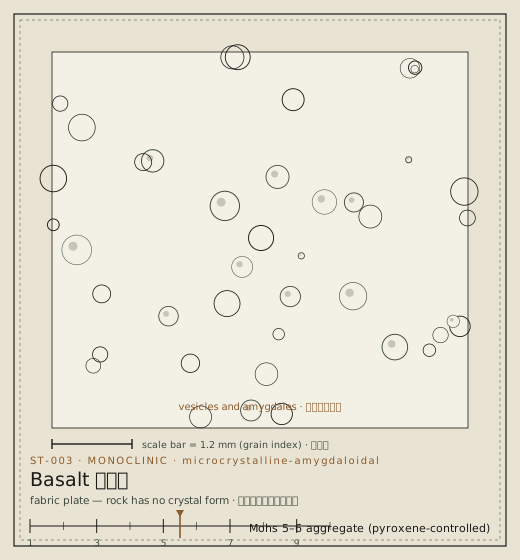
Specimen properties
| Sheet | ST-003 |
|---|---|
| Chemical formula | Plagioclase (Ca-rich) + clinopyroxene + olivine; SiO₂ about 45–52 wt% |
| Classification | Volcanic · mafic火山岩 · 镁铁质 |
| Hardness, Mohs | 5–6 aggregate (pyroxene-controlled) |
| Streak | Grey-white, faint; the rock is too fine-grained to give a strong streak灰白色、浅淡;岩石过细粒,条痕不明显 |
| Lustre | Dull to slightly vitreous; fresh surfaces look almost greasy暗淡至微具玻璃光泽;新鲜面近乎油脂感 |
| Cleavage | Not visible at hand-specimen scale; pyroxene splits on two directions at about 90°手标本尺度不可见;辉石沿两组近 90° 方向解理 |
| Fracture | Uneven to subconchoidal; the rock breaks across the groundmass不平坦至亚贝壳状;岩石沿基质断开 |
| Colour | Dark grey to black; weathered surfaces take on a pale grey or rusty film深灰至黑色;风化面覆一层浅灰或锈色薄膜 |
| Crystal system | monoclinic |
| Crystal habit / fabric | microcrystalline-amygdaloidal · 5-fold · 2 cleavage dir. |
| Published | 2026-09-03 |
Related formulae
CaAl₂Si₂O₈ · (Ca,Mg,Fe)₂Si₂O₆ · (Mg,Fe)₂SiO₄
Field tests, in order
Why the grain size tells the whole story
Basalt and gabbro have the same chemistry. They differ only in cooling rate. Basalt erupted at the surface lost its heat in days to months, so its crystals stayed under a millimetre and the rock reads as a uniform dark mass. Gabbro stalled kilometres down and grew crystals you can measure with a ruler. This is the single most useful fact about basalt in the field: if you can see the individual crystals, you are almost certainly not holding basalt.
Reading a fresh face
Weathering turns basalt into a pale grey shell that hides everything, so spend the extra minute to find a fresh break.
- Wet the surface. Fresh basalt darkens dramatically and looks faintly greasy; weathered basalt just looks wet.
- Look for green-black specks. Those are clinopyroxene; a scattering of them in a dark fine matrix is the classic basalt texture.
- Check for olivine. Glassy yellow-green grains, often in clusters, mark olivine basalt — common in ocean-island flows.
- Confirm the absence of quartz. Grey translucent quartz is the thing you should not find.
Vesicles, amygdales and columnar jointing
Basalt records its own cooling history in structures that survive far better than the minerals do.
| Structure | What it means |
|---|---|
| Round vesicles, 1–10 mm | Gas bubbles that were trapped as the lava froze; the flow was near the surface |
| Amygdales | Vesicles later filled by calcite, zeolite, chalcedony or agate — collect these |
| Columnar jointing | Contraction on cooling, cracking from the base upward; columns are perpendicular to the cooling surface |
| Pahoehoe vs ʻaʻā | Ropy smooth crust (low viscosity, hot) versus jagged clinker (cooler, more degassed) |
Where you meet it in the field
Ocean crust is basalt everywhere: the mid-ocean ridge system produces roughly 20 cubic kilometres of it every year, and the entire seafloor is a basalt-and-sediment sandwich. On land you find it in flood-basalt provinces such as the Columbia Plateau, the Deccan Traps and the Emeishan province, in the cinder cones and shield volcanoes of Hawaiʻi and Iceland, and in the eroded remnants of Palaeogene flows along the North Atlantic coast. The Giant's Causeway columns and the Faroes sea-cliffs are the same rock, erupted by the same event, 60 million years ago.
Working safely and taking useful samples
The practical risks are glass-sharp edges, loose lava crust, and hammering into a face above your head. Wear eye protection, never hammer a cliff from below, and never sample an active or recent flow without permission — many are protected and some are still hot a metre down. For a study collection, one dense specimen and one amygdaloidal specimen per locality, each at least 8 cm across, will support every test you are likely to run.
Representative localities
Confused with, and how to separate them
Identical chemistry and mineralogy, but gabbro cooled slowly enough to show visible crystals
Both can be black and glassy-looking, but obsidian has a true conchoidal fracture and is translucent at thin edges
Collecting and storage
Basalt is hard on tools and harder on fingers: the fine grain means sharp edges that cut like glass. Take freshly broken blocks rather than weathered rinds, and if the site is an active flow, stay off it — Hawaiian and Icelandic flows have crusts that look solid and are not. Vesicle fillings are the interesting part of a basalt collection, so keep one amygdaloidal piece and one dense piece from every locality.
Key points
- Basalt and gabbro are chemically identical; grain size, not composition, separates them in the field.
- Fresh surfaces are dark and faintly greasy; weathered surfaces are pale grey and hide everything.
- Vesicles and amygdales are the key field structures — and the best thing to collect.
- Columnar jointing forms perpendicular to the cooling surface and indicates a lava flow or shallow sill.
- Ocean crust is basalt; flood provinces, shield volcanoes and cinder cones are the land exposures.