Limestone
石灰岩
Limestone is the easiest of the common rocks to identify and the hardest to identify well, because one drop of acid answers the first question and leaves every interesting question untouched. It is a carbonate rock, mostly calcite, and it can form from shells, from chemical precipitation or from reworked fragments of older limestone — three very different origins that a hand specimen must be read carefully to distinguish.
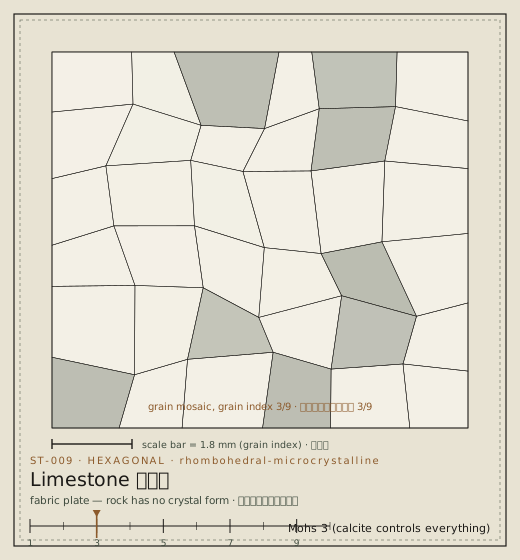
Specimen properties
| Sheet | ST-009 |
|---|---|
| Chemical formula | CaCO₃, mostly as calcite, with variable clay, silica and magnesium |
| Classification | Biochemical · carbonate生物化学岩 · 碳酸盐 |
| Hardness, Mohs | 3 (calcite controls everything) |
| Streak | White to pale grey白色至浅灰 |
| Lustre | Dull to earthy; crystalline varieties have a faint pearly sheen on fresh faces暗淡至土状;结晶质变种的新鲜面有微弱珍珠光泽 |
| Cleavage | Three perfect directions at 75° in the calcite rhombs, though rarely visible at rock scale方解石菱面体具三组完全解理,夹角约 75°,但在岩石尺度上少见 |
| Fracture | Even to uneven; the rock tends to break along bedding or joint surfaces平坦至不平坦;岩石常沿层面或节理面断开 |
| Colour | White, cream, pale grey, buff, blue-grey or black白、米、浅灰、米黄、蓝灰或黑色 |
| Crystal system | hexagonal |
| Crystal habit / fabric | rhombohedral-microcrystalline · 6-fold · 3 cleavage dir. · twinned |
| Published | 2026-09-11 |
Related formulae
CaCO₃ · MgCO₃ · SiO₂
Field tests, in order
One drop of acid, then stop
Ten percent hydrochloric acid, or dilute muriatic acid from a hardware shop, is the standard field reagent. Applied to limestone it fizzes immediately and vigorously, because calcite is soluble in weak acid and releases carbon dioxide. That single response separates limestone from every other pale rock you are likely to meet, including dolomite, which reacts sluggishly unless you powder the sample or warm the acid, and chert, which does not react at all. Carry the acid in a small dropper bottle and always test on a broken surface rather than a weathered rind.
Three origins, three textures
How the limestone formed is written into its fabric, and it is worth classifying on the spot.
| Type | How to recognise it | Origin |
|---|---|---|
| Chalk | White, soft, dull, sticks to the fingers; whole-rock is microscopic coccolith plates | Planktonic algae settling on a deep sea floor |
| Fossiliferous limestone | Visible shells, crinoid ossicles, coral or bryozoan fragments | Shallow shelf accumulation of skeletal debris |
| Oolitic limestone | Uniform 0.5–1 mm spheres, like tiny fish roe | Chemical precipitation around grains rolled in warm shallow water |
| Micrite / lime mudstone | Uniform dull grey, no visible grains or fossils | Fine carbonate mud, often deposited in calm water |
| Reef limestone | Massive, unbedded, with in-place coral framework | A reef that grew in place and was cemented by encrusters |
Karst: what the rock does to the landscape
Calcite dissolves in slightly acidic rainwater, and given a few million years that produces the karst suite: sinkholes, caves, disappearing streams, dry valleys and, in the wet tropics, the tower karst of Guilin and Ha Long. The chemistry is simple — carbon dioxide plus water makes carbonic acid, which converts calcite into soluble calcium bicarbonate — but the consequences are not. A limestone region drains underground rather than across the surface, which means it stores water in conduits rather than in pores, floods suddenly and pollutes easily. Caves in limestone preserve records that nothing else does: stalagmite layers can be dated by uranium-series methods and give a continuous climate record stretching back hundreds of thousands of years.
Field hazards and useful measurements
Two things deserve care. First, limestone is soft and dissolve-prone, so a hammer blow on a joint face can drop a block that has been quietly loosened by decades of solution — a helmet is not excessive on a karst cliff. Second, limestone dust is alkaline and an eye irritant. For the notebook, record whether the rock fizzes on a fresh or a weathered surface, its bed thickness, the presence and type of fossils, and the joint orientation: on limestone pavements you can measure the two dominant joint sets directly from the grykes, which is a rare chance to read structure off a flat surface.
Why limestone keeps mattering
Limestone is the raw material for Portland cement, for agricultural lime, for steel flux and for a large fraction of the world's CO₂ storage research, because calcium carbonate reacts readily with carbon dioxide. It also holds roughly a quarter of the world's oil and gas reserves in its pore systems and reefs. For a collector, that means many quarries are active industrial sites and many caves are protected scientific reserves — check before you collect, and document rather than remove where the site is sensitive.
Representative localities
Confused with, and how to separate them
The most common confusion: dolomite reacts weakly with acid and is slightly harder
Both can be pale and dull, but chert will not fizz and is far harder
Collecting and storage
Limestone is soft and dissolves, so specimens collected from an exposed face can arrive home as a bag of white paste — wrap them and keep acid away from everything else in the pack. Fossils should be left in situ unless they are already loose; a crinoid stem removed from its bed loses the stratigraphic information that makes it useful. Karst and cave systems are frequently protected, and collecting from them is usually illegal.
Key points
- One drop of dilute hydrochloric acid separates limestone from dolomite and chert in seconds.
- Chalk, oolitic, fossiliferous, micritic and reef limestone are distinguished by texture, not chemistry.
- Karst drainage is underground, which makes limestone regions flood-prone and pollution-sensitive.
- Stalagmites in limestone caves provide datable climate records spanning hundreds of thousands of years.
- Record bed thickness, joint sets (measurable from grykes), fossil type and whether the acid test was on a fresh surface.