Granodiorite
花岗闪长岩
Granodiorite looks like a slightly dirty granite and is routinely filed as one. It is the most abundant plutonic rock in the continental crust, and the difference from true granite is not colour but chemistry: plagioclase outweighs alkali feldspar, and hornblende joins biotite in the dark-mineral slot.
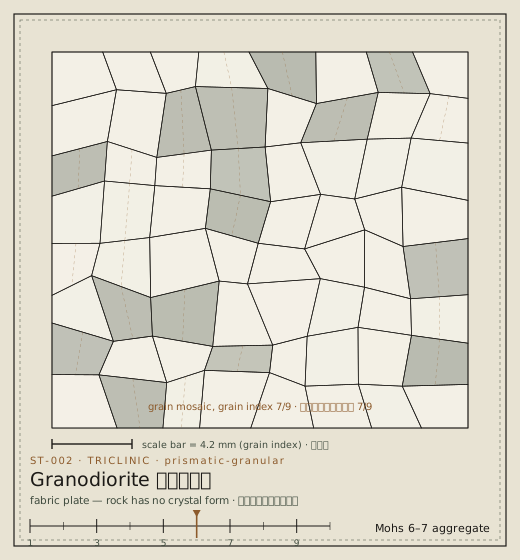
Specimen properties
| Sheet | ST-002 |
|---|---|
| Chemical formula | Quartz SiO₂ + plagioclase (NaAlSi₃O₈–CaAl₂Si₂O₈) + hornblende + biotite |
| Classification | Plutonic · intermediate深成岩 · 中酸性 |
| Hardness, Mohs | 6–7 aggregate |
| Streak | White to pale grey白色至浅灰 |
| Lustre | Vitreous, with a distinctly greasy look on weathered hornblende玻璃光泽,风化的角闪石呈明显的油脂感 |
| Cleavage | Two good directions at about 60° and 120° in hornblende; perfect basal cleavage in biotite角闪石两组约 60° 与 120° 的良好解理;黑云母一组极完全底面解理 |
| Fracture | Uneven, hinging around the hornblende prisms不平坦,断口绕角闪石柱体转折 |
| Colour | Medium grey with a salt-and-pepper texture; distinctly darker than granite中灰色带椒盐状斑纹,明显深于花岗岩 |
| Crystal system | triclinic |
| Crystal habit / fabric | prismatic-granular · 4-fold · 2 cleavage dir. · twinned |
| Published | 2026-10-04 |
| Byline | By The Specimen Desk |
Related formulae
SiO₂ · NaAlSi₃O₈ · CaAl₂Si₂O₈ · Ca₂(Mg,Fe)₄Al(Si₇Al)O₂₂(OH)₂
Field tests, in order
Why it is so often mislabelled
Field guides list the feldspars as a pair and leave it there, which is useless when both are white and both are 6 on Mohs' scale. The distinction is quantitative. In granite the pink or cream alkali feldspar is the dominant pale mineral; in granodiorite it steps aside and white plagioclase takes roughly two-thirds of the feldspar budget. On a weathered surface the plagioclase turns chalky and hides under lichen, so the rock reads as a plain grey stone and gets called granite by default.
The field procedure that actually works
Break the specimen. Weathered rinds destroy this identification more often than the observer does.
- Find a fresh face and wet it. The plagioclase becomes bright white; the alkali feldspar stays dull and slightly creamy.
- Look at the dark minerals. Black bladed prisms with blunt ends mean hornblende and point away from granite.
- Estimate total dark minerals. Around 15–25% is granodiorite; over 40% with no quartz means you are into gabbro.
- Check the quartz. It should still be obvious, glassy and grey, at 15–25% of the rock.
The Sierra Nevada connection
Granodiorite is not a curiosity — it is what most subduction-zone magma turns into when it stalls and crystallises at depth. The Sierra Nevada batholith is the classic example: hundreds of individual plutons of Cretaceous granodiorite, intruded between about 120 and 85 million years ago, now exposed over tens of thousands of square kilometres. The same rock type built the Peninsular Ranges, the Coast Plutonic Complex of British Columbia and a large share of the Andean batholiths. If you are standing on a grey coarse-grained rock in a mountain belt that grew at an ocean margin, granodiorite is the safe first guess.
Texture, alteration and what to note
Granodiorite weathers in a particular way that is worth capturing in your notes. Hornblende breaks down to chlorite and epidote first, turning the dark prisms green and then soft; plagioclase alters to sericite and clay, leaving a rock surface that is strikingly light and powdery. Fresh surfaces only exist inside joints. If you cannot find one, channel a sample from 5 cm inside the face and bag it wet.
Why the distinction matters beyond a name
Granodiorite versus granite is a real geological boundary, not a labelling nicety. It marks a change in the source of the melt and in the amount of mantle material mixed into it. Mapping that boundary across a pluton tells you where the magma chamber was fed and how it evolved. That is why a collection should record the feldspar ratio explicitly rather than filing the rock away under "granite, grey".
Sources
Hardness, streak, cleavage and specific-gravity values quoted on this sheet are checked against the references below.
- Geology.com Rocks — rock-type reference — descriptions and photographs of igneous, sedimentary and metamorphic rocks
- Geology.com Mineral Encyclopedia — mineral property database — hardness, cleavage, streak, specific gravity and chemical composition per mineral
- British Geological Survey — UK national geological survey — the three rock types, the rock cycle and mineral definitions
Representative localities
Confused with, and how to separate them
Same texture and setting; the difference is which feldspar wins, which usually needs a fresh surface and oblique light
Darker and, in the hand, very similar in texture — but gabbro has calcium-rich plagioclase with no quartz at all
Collecting and storage
Granodiorite is the most mislabelled rock in amateur collections, so note the plagioclase-to-alkali-feldspar ratio on the label while the specimen is fresh. Hornblende alters to chlorite and epidote within a few seasons outdoors; a wet, bagged specimen keeps its colour long enough to compare properly.
Key points
- Granodiorite is defined by plagioclase outweighing alkali feldspar, with hornblende normally present.
- Dark minerals run 15–25%, against under 15% in true granite.
- Hornblende's blunt black prisms are the most visible single clue in the field.
- It is the dominant plutonic rock of continental-margin mountain belts such as the Sierra Nevada.
- Label the plagioclase-to-alkali-feldspar ratio while the specimen is fresh; weathering hides it fast.