Granite vs granodiorite
花岗岩与花岗闪长岩对照
These two rocks sit next to each other in every classification chart and are routinely confused in the field, because they share their texture, their grain size, most of their minerals and their hardness. Only four observable properties separate them, and all four are quantitative. This sheet is the procedure to run when a grey coarse-grained rock could reasonably be either.
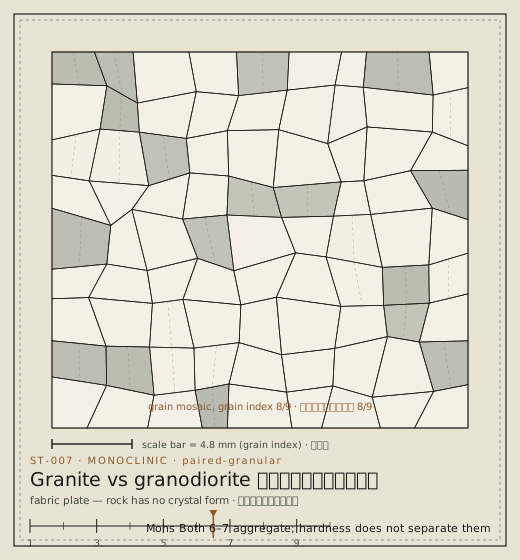
Specimen properties
| Sheet | ST-007 |
|---|---|
| Chemical formula | Difference is in the feldspar budget: alkali feldspar-dominant versus plagioclase-dominant |
| Classification | Comparative sheet · plutonic felsic pair对照卡 · 深成长英质成对标本 |
| Hardness, Mohs | Both 6–7 aggregate; hardness does not separate them |
| Streak | Both white; useless as a discriminator here两者均为白色,在此无法作为区分依据 |
| Lustre | Both vitreous; hornblende in granodiorite adds a dull black, bladed element两者均玻璃光泽;花岗闪长岩中的角闪石增加了一种暗淡的黑色板状要素 |
| Cleavage | Same in both; the feldspars both show two directions near 90°两者相同;两种长石均呈两组近 90° 解理 |
| Fracture | Both uneven and interlocking; no field difference两者均不平坦且镶嵌紧密,野外无差异 |
| Colour | Granite reads lighter and often pinkish; granodiorite reads mid-grey花岗岩整体更浅、常带粉调;花岗闪长岩呈中灰 |
| Crystal system | monoclinic |
| Crystal habit / fabric | paired-granular · 5-fold · 2 cleavage dir. · twinned |
| Published | 2026-09-18 |
Related formulae
KAlSi₃O₈ (alkali) · NaAlSi₃O₈–CaAl₂Si₂O₈ (plagioclase)
Field tests, in order
Why the distinction is genuinely hard
Both are coarse-grained intrusive rocks with interlocking crystals of 3–10 mm, both contain quartz, both contain two feldspars, and both are 6–7 on Mohs' scale. There is no single grain you can point at and say "that one decides it". The name depends on ratios: which feldspar is more abundant, how much dark mineral is present, and how much quartz there is. Two observers looking at the same weathered specimen will disagree, and that is expected rather than a failure.
The four measurements, in order
Run them in this sequence, because each one is easier to judge than the next.
- Feldspar identity. Wet a fresh surface. Alkali feldspar is cream, salmon or pink and slightly dull; plagioclase is white or grey and brighter. Whichever dominates by roughly two to one names the rock.
- Dark mineral percentage. Estimate across a full 5 cm face, not a corner. Under 15% points to granite, 15–25% to granodiorite.
- Hornblende presence. Look for black prisms with blunt, ragged ends. Hornblende is normal in granodiorite and rare in granite.
- Quartz fraction. Over 25% leans granite; 15–25% leans granodiorite. This is the least reliable of the four and is used as a tie-breaker.
What the answer actually means
This is not a naming game. The feldspar ratio tracks the composition of the melt and the amount of mantle-derived material mixed into it. Granodiorite is the typical product of a subduction-zone arc, where mantle wedge melting and crustal melting combine. True granite is more often the product of continental collision, where existing crust is remelted with little new mantle input. Finding granodiorite tells you the region was probably an active margin; finding granite tells you it was probably thickened crust that got hot enough to melt itself.
Recording a paired specimen set
If a single outcrop shows both, that outcrop is worth far more than two specimens from separate sites, because the transition itself is the data.
| Record | Why it matters |
|---|---|
| Distance and direction between the two sample points | Gives you the width of the transition zone |
| Whether the contact is sharp or gradational | Sharp contacts suggest separate intrusions; gradational suggests one body that fractionated |
| Feldspar ratio at both points | The actual measurement that justifies the two names |
| Fresh versus weathered surfaces photographed in the same light | Colour comparison only works if the lighting matches |
A note on published names
Older geological maps and guidebooks use the word granite loosely for any coarse pale intrusive rock, and many well-known localities are labelled that way. If you are comparing your specimen to a map, expect a mismatch and trust your own measurements. Where a modern geochemical analysis exists it will normally report both a normative feldspar ratio and a name, and those are the numbers worth recording in a collection catalogue.
Criterion by criterion
| Criterion | granite | granodiorite |
|---|---|---|
| Dominant feldspar | Alkali feldspar (pink or cream) | Plagioclase (white or grey) |
| Dark minerals | Under 15%, biotite dominant | 15–25%, hornblende and biotite |
| Quartz | 20–40% | 15–25% |
| Typical setting | Continental collision and crustal melting zones | Continental-margin arcs above subduction zones |
| Overall tone on a broken face | Light, warm, speckled | Mid-grey, salt-and-pepper |
Representative localities
Confused with, and how to separate them
Both contain the same minerals in the same proportions; gneiss has a banded fabric instead of a random mosaic
Listed for completeness: this sheet exists to separate granite from granodiorite specifically
Collecting and storage
Sample both from the same outcrop if you can. A single pluton often grades from granodiorite at the margin to granite in the core, and a paired set from one locality teaches more than two specimens from different countries. Break fresh surfaces on both and photograph them side by side in the same light, otherwise the colour comparison is meaningless.
Key points
- Four quantitative properties separate the pair: dominant feldspar, dark-mineral percentage, hornblende presence and quartz fraction.
- Under 15% dark minerals and over 25% quartz points to granite; 15–25% and 15–25% points to granodiorite.
- Granodiorite is the subduction-arc rock; granite is more often a collision-zone melt.
- Sample both from one outcrop if possible — the transition is the most useful evidence.
- Many older maps use "granite" loosely, so trust measured ratios over printed names.