Gabbro
辉长岩
Gabbro is what basalt becomes when it is given time. Identical in chemistry, it is the coarse-grained plutonic equivalent of the ocean floor's most common rock — and it is best known not for the surface it makes but for the layered intrusions it forms at depth, some of which hold the world's platinum supply.
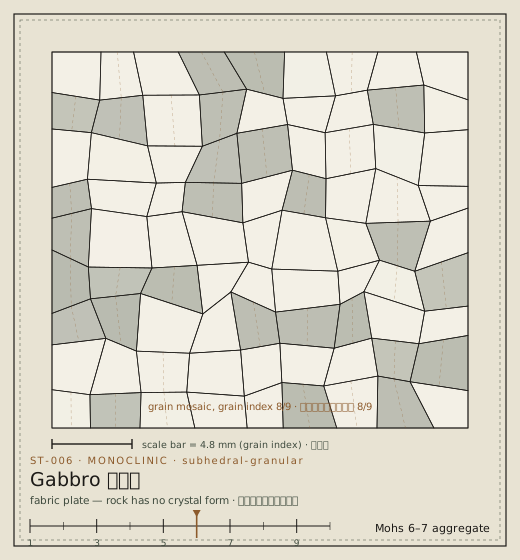
Specimen properties
| Sheet | ST-006 |
|---|---|
| Chemical formula | Ca-rich plagioclase + clinopyroxene + olivine; SiO₂ about 45–52 wt% |
| Classification | Plutonic · mafic深成岩 · 镁铁质 |
| Hardness, Mohs | 6–7 aggregate |
| Streak | White to pale grey白色至浅灰 |
| Lustre | Vitreous on plagioclase, submetallic to silky on pyroxene cleavage faces斜长石玻璃光泽;辉石解理面半金属至丝绢光泽 |
| Cleavage | Two directions at nearly 90° in pyroxene; two at about 60°/120° in plagioclase辉石两组近 90° 解理;斜长石两组约 60°/120° 解理 |
| Fracture | Uneven, interlocking; the rock is tough and hard to break cleanly不平坦、镶嵌紧密;岩石坚韧,很难干净断开 |
| Colour | Dark grey to nearly black with a glittering speckled texture深灰至近黑,带闪鳞状斑点结构 |
| Crystal system | monoclinic |
| Crystal habit / fabric | subhedral-granular · 5-fold · 2 cleavage dir. · twinned |
| Published | 2026-10-28 |
| Byline | By The Specimen Desk |
Related formulae
CaAl₂Si₂O₈ · (Ca,Mg,Fe)₂Si₂O₆ · (Mg,Fe)₂SiO₄ · FeTiO₃
Field tests, in order
The same rock, cooled slowly
Gabbro and basalt share a bulk composition: calcium-rich plagioclase, clinopyroxene, often some olivine, and no more than a trace of quartz. Erupt that magma and you get basalt. Let the same magma sit in a chamber a few kilometres down and it grows crystals of 2–10 mm, and the rock becomes gabbro. Geologists call this pair a compositional series with a grain-size split. It is also why gabbro is such a large share of the lower ocean crust: at mid-ocean ridges, the melt that does not erupt ponds and crystallises into a gabbro layer a few kilometres thick, sitting between the mantle below and the sheeted dykes above.
Identifying it in the hand
Gabbro's texture is unfriendly to quick identification because everything is the same dark grey. Work through it in a fixed order.
- Find a fresh broken face and wet it. Weathered gabbro is uniformly dull; fresh gabbro sparkles.
- Look at the plagioclase. It is grey and glassy with visible lath shapes — not pink, not chalky white.
- Tilt the specimen in the sun. Pyroxene cleavage faces flash as the angle changes; that glitter is diagnostic.
- Confirm no quartz. If there is translucent grey quartz, you are in granodiorite territory.
Layered intrusions: the real prize
The Bowen reaction series explains most of gabbro's behaviour, but layered complexes are what make it interesting to collect from. Where a large body of mafic magma sits and cools slowly, dense minerals — olivine, then pyroxene, then plagioclase — settle out in sequence, building a stack of layers that can be hundreds of metres thick and rhythmically banded. The Bushveld Complex in South Africa is the largest example, and its chromitite and merensky reef layers carry most of the world's platinum, palladium and chromium. In Skye's Cuillin centre, the same process operated at a small scale and the rhythmic banding is visible in a single cliff face, which is a rare convenience.
Where you meet it on the surface
Gabbro reaches the surface in three settings. It forms the guts of large ophiolites, the slivers of ocean crust that get obducted onto continents — the Oman ophiolite exposes a full section from mantle peridotite through gabbro to pillow basalt. It forms the lower parts of layered complexes, often exposed after kilometres of uplift. And it forms the cores of some large mafic intrusions, including the Skaergaard in Greenland, where decades of study produced much of what is known about how mafic magma differentiates. All three settings are worth a field visit precisely because the rock cannot form at the surface.
Field notes and safety
Gabbro weathers to a plain dark grey and looks unremarkable from a distance, so record the texture evidence in the field rather than trusting your memory later. It is also a durable, hard rock that resists the hammer — a 1 kg sledge or a chisel and a 2 kg lump hammer are more useful than a geological pick on a big exposure. Because many layered complexes host ore minerals, some are protected or actively mined; check whether the face you are approaching is a working quarry before you swing.
Sources
Hardness, streak, cleavage and specific-gravity values quoted on this sheet are checked against the references below.
- Geology.com Rocks — rock-type reference — descriptions and photographs of igneous, sedimentary and metamorphic rocks
- British Geological Survey — UK national geological survey — the three rock types, the rock cycle and mineral definitions
Representative localities
Confused with, and how to separate them
Same minerals, same colour, but you cannot see individual crystals in basalt
Similar texture, but granodiorite has visible quartz and lighter feldspar
Collecting and storage
Gabbro is a tough, heavy rock and a full-size hand sample of 12 cm will weigh close to 4 kg. Take a smaller piece — the interlocking texture means any fresh broken surface shows the mineralogy perfectly. Layered gabbro is worth sampling as a vertical sequence rather than as single specimens: the rhythmic banding is the whole point, and one hand sample destroys that context.
Key points
- Gabbro is the slow-cooled, coarse-grained equivalent of basalt: same chemistry, different grain size.
- Grey glassy plagioclase laths and flashing pyroxene cleavage faces are the field signature.
- The absence of quartz separates it from granodiorite, which has the same texture.
- Layered intrusions such as Bushveld concentrate platinum-group metals into thin, distinctive bands.
- Most exposed gabbro comes from ophiolites or uplifted intrusions — it does not form at the surface.