Bituminous coal
烟煤
Coal is the one common rock that is biological rather than mineral in origin. It is the compacted and chemically altered remains of plants that grew in swamp forests and were buried before they could decay, and every field property it has — banding, cleat, streak, sulphur content — traces back to that origin.
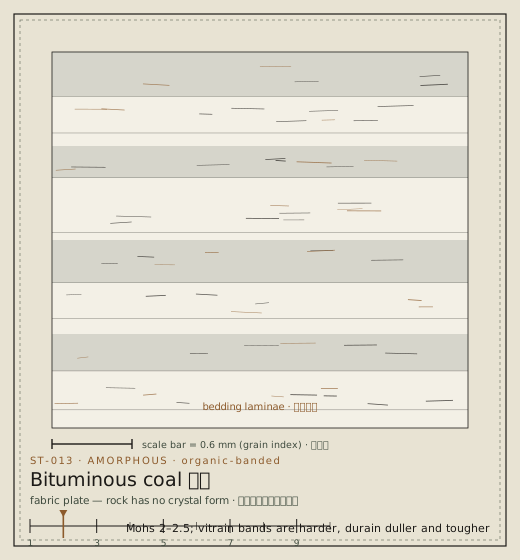
Specimen properties
| Sheet | ST-013 |
|---|---|
| Chemical formula | Variable: carbon 60–80 wt%, plus hydrogen, oxygen, nitrogen, sulphur and mineral ash |
| Classification | Organic · combustible rock有机岩 · 可燃岩 |
| Hardness, Mohs | 2–2.5; vitrain bands are harder, durain duller and tougher |
| Streak | Black to dark brown; a distinctive dark brown streak on unglazed tile黑至深褐;在无釉瓷板上留下特有的深褐色条痕 |
| Lustre | Vitreous to resinous on bright bands, dull on durain bands — hence "banded"亮煤条带玻璃至树脂光泽,暗煤条带暗淡——故称「条带状」 |
| Cleavage | Two sets controlled by the original plant bedding and by cleat fractures两组,受原始植物层理与内生裂隙(割理)控制 |
| Fracture | Conchoidal in vitrain, uneven and splintery in durain亮煤呈贝壳状,暗煤呈不平坦的参差状 |
| Colour | Black, with a brownish tinge in lower-rank varieties黑色,较低煤阶的变种带褐色调 |
| Crystal system | amorphous |
| Crystal habit / fabric | organic-banded · 0-fold · 2 cleavage dir. |
| Published | 2026-10-31 |
| Byline | By The Specimen Desk |
Related formulae
C · CH₄ · FeS₂ (pyrite)
Field tests, in order
From peat to anthracite
The sequence is called coalification, and rank is simply how far along it a sample has travelled. Peat is the starting material: loose plant debris, over 75 percent water. Burial compresses it, expels water and volatiles, and drives off oxygen and hydrogen, raising the carbon content. Lignite is brown and soft; sub-bituminous and bituminous coals are the workhorse grades with 60 to 80 percent carbon; anthracite, above about 90 percent carbon, is hard, shiny and nearly smokeless. Each step requires both deeper burial and more time, which is why Carboniferous coals are typically higher rank than Tertiary ones buried to the same depth.
The four lithotypes you can see
Bituminous coal is banded at centimetre scale, and the bands are named lithotypes. Recognising them tells you what kind of swamp the coal came from.
| Lithotype | Appearance | Origin |
|---|---|---|
| Vitrain | Bright, glassy, black, breaks conchoidally | Woody tissue — trunks and branches, the most gelified plant material |
| Clarain | Semi-bright, finely banded | Mixed fine plant debris with some woody content |
| Durain | Dull, hard, granular-looking | Spores, cuticles and algal material; often high in ash |
| Fusain | Silky, fibrous, charcoal-like, friable | Fossil charcoal from ancient wildfires |
Cleat, and why it matters
Almost every coal seam has two sets of natural fractures, called cleat, that are roughly perpendicular to the bedding and to each other. The face cleat is continuous and the butt cleat terminates against it. Cleat forms as the seam shrinks during coalification and as the rock is later stressed. It matters for three reasons: it controls how the coal breaks when mined, it provides the permeability that lets coalbed methane be extracted, and in some basins its orientation records the regional stress field at the time of fracturing. If you are measuring a seam, cleat spacing and orientation are worth recording alongside the banding.
What to record at an exposure
Natural coal exposures are rare; most are sea cliffs or river cuts where a seam is visible in cross-section. Record the seam thickness, the number and thickness of the individual benches, the lithotype proportions, the nature of the roof and floor rock, and any plant fossils in the associated mudstones. Coal balls — carbonate nodules in the seam that preserve plant anatomy in three dimensions — are scientifically valuable, so photograph and report them rather than collecting. If you are working a coastal exposure, note that coal seams undercut by waves cause cliff collapse.
The safety rules that actually matter
Coal is the most hazard-laden common rock to collect. Abandoned mine workings produce carbon dioxide and methane that accumulate in low ground and in any confined space, and both are lethal; never enter an adit. Spoil tips are unstable and slump without warning, especially after rain. Coal dust from breaking specimens is a respiratory irritant and a long-term hazard. And a large, damp, tightly packed pile of bituminous coal can self-heat to ignition. Collect small pieces from loose material, at the surface, in daylight.
Sources
Hardness, streak, cleavage and specific-gravity values quoted on this sheet are checked against the references below.
- Geology.com Rocks — rock-type reference — descriptions and photographs of igneous, sedimentary and metamorphic rocks
- British Geological Survey — UK national geological survey — the three rock types, the rock cycle and mineral definitions
- National Geographic Society — established educational publisher — encyclopaedic entry on the rock cycle
Representative localities
Confused with, and how to separate them
Black shale and coal can both be dark and fissile, but shale leaves a grey smear and coal a brown-black streak
Both are black and shiny, but obsidian is much harder and translucent at thin edges, while coal is soft and opaque
Collecting and storage
Coal specimens are chemically active and will crumble in storage; coal also spontaneously combusts in large heaps and weathers to a sludge within a few years if kept damp. Store dry, bag separately, and never collect from a working face, a spoil tip or an abandoned mine entrance — coal tips slump without warning, mine gases are lethal, and most coalfields are on private or regulated land. Coal dust is a respiratory hazard; a P2 mask is appropriate wherever you are breaking it.
Key points
- Coal rank is a burial-and-time sequence from peat through lignite and bituminous to anthracite.
- Bright vitrain, semi-bright clarain, dull durain and fibrous fusain record different plant inputs.
- Cleat is a natural fracture network in two perpendicular sets that controls permeability and fragmentation.
- A brown streak places a sample above lignite; a black streak and conchoidal fracture suggest higher rank.
- Never enter abandoned mine workings and never collect from a face or a spoil tip — the hazards are fatal ones.