Shale
页岩
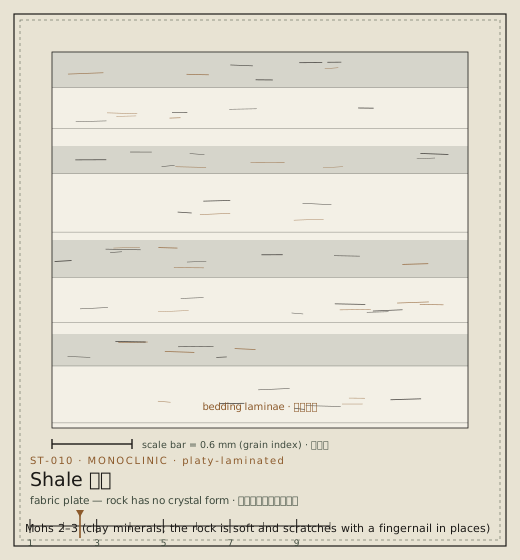
Shale accounts for more than half of all sedimentary rock in the record and gets almost none of the attention. It is a mudrock — clay minerals, fine silt and often a few percent of organic carbon — and its defining property is fissility: it splits into sheets along the bedding because the clay flakes settled flat and stayed that way.
Specimen properties
| Sheet | ST-010 |
|---|---|
| Chemical formula | Clay minerals + quartz silt + organic carbon; illite and kaolinite dominate |
| Classification | Clastic · mudrock碎屑岩 · 泥质岩 |
| Hardness, Mohs | 2–3 (clay minerals; the rock is soft and scratches with a fingernail in places) |
| Streak | Grey to dark grey; a distinctive dull smear rather than a powder灰至深灰;呈特有的暗淡涂抹痕而非粉末 |
| Lustre | Dull, earthy; slightly silky along bedding planes暗淡土状;沿层面略带丝绢光泽 |
| Cleavage | Perfect fissility along bedding — the defining property of the rock沿层面完全易剥性——本岩石的决定性特征 |
| Fracture | Splinters into thin flakes; breaks along bedding rather than across it劈成薄片;沿层面而非横穿层面断开 |
| Colour | Grey to black; red and green varieties reflect oxidising or reducing conditions灰至黑色;红、绿变种反映氧化或还原环境 |
| Crystal system | monoclinic |
| Crystal habit / fabric | platy-laminated · 2-fold · 1 cleavage dir. |
| Published | 2026-09-25 |
| Byline | By The Specimen Desk |
Related formulae
(K,H₃O)Al₂Si₃AlO₁₀(OH)₂ · Al₂Si₂O₅(OH)₄ · SiO₂
Field tests, in order
Fissility is the whole identification
The test takes three seconds. Pick up the specimen and try to split it with a knife blade parallel to the visible lamination. Shale comes apart in sheets less than five millimetres thick with almost no resistance, and the split surfaces are dull and slightly rough. Mudstone has the same composition and the same grain size but no fissility — it breaks in blocky, irregular chunks. The difference is not chemistry; it is whether the clay flakes had time to settle and align quietly, or were dumped quickly in a slurry that set in a chaotically oriented mass.
Colour as an environmental indicator
Shale colour is a redox indicator and it is more informative than most field properties.
- Black: organic carbon above about 1% preserved because the sediment sat below the oxygenated zone. Black shale is the source rock for a large share of the world's oil and gas.
- Grey to green: moderate organic content, deposited in dysoxic conditions; green reflects ferrous iron in clay.
- Red or maroon: fully oxidised, no preserved organic matter; the sediment was exposed to oxygen throughout deposition.
- Banded red and grey: fluctuating oxygen levels, often in a marginal marine or lacustrine setting.
Why it matters far beyond a field guide
Fine-grained mudrock is where the geological record is most complete, because fine sediment accumulates slowly and buries things gently. The Burgess Shale in British Columbia preserved the soft tissues of Cambrian animals — legs, gills, guts — that no other rock type recorded, and that single formation rewrote the history of early animal life. Black shales also hold the world's largest unconventional hydrocarbon resource and are the focus of most current carbon-capture research, because clay-rich rock adsorbs carbon dioxide well. Whether you are interested in fossils, energy or climate, shale is where the important problems concentrate.
Collecting and handling
Two practical rules. First, split in the field: shale that dries and re-wets will crumble along internal planes, and the clean split you want is only available while the rock is damp. Second, know the site rules. Many of the best shale localities are protected — Burgess Shale collecting is prohibited outright and a permit is required even to visit — and black shale outcrops can be unstable, with a tendency to slab off in plates at head height. Helmets and caution are appropriate, and pyritic black shale will rust and stain anything stored next to it.
Reading bedding in a shale sequence
Because shale splits along bedding, a fresh road cut or coastal section gives you a continuous readable surface that sandstone cannot match. Measure laminate thickness in millimetres, note whether the sequence is rhythmically banded, and look for graded beds and sole marks on the underside of siltier laminae — those record individual turbidity currents and give you a current direction. A season of measuring a shale section produces a far more detailed environmental history than the same effort spent on coarser rocks.
Sources
Hardness, streak, cleavage and specific-gravity values quoted on this sheet are checked against the references below.
- Geology.com Rocks — rock-type reference — descriptions and photographs of igneous, sedimentary and metamorphic rocks
- British Geological Survey — UK national geological survey — the three rock types, the rock cycle and mineral definitions
Representative localities
Confused with, and how to separate them
Slate splits along a cleavage that cuts across the original bedding; shale splits along the bedding itself
Phyllite has a silky sheen and a crinkled cleavage surface; shale is dull and flat
Collecting and storage
Shale decomposes in storage. Freshly collected pieces dry out, crack along bedding and within a year turn into a pile of flakes, so seal them, label them, and keep black shale away from anything you care about — it can be pyritic and will rust. If you are sampling for fossils, take the whole slab and split it at the locality, because shale that has been through a freeze-thaw cycle will never split cleanly again.
Key points
- Fissility — splitting into sub-5 mm sheets along bedding — is the whole field identification.
- Mudstone has the same composition as shale but no fissility and breaks in blocks.
- Colour records oxygen levels: black is organic-rich and reducing, red is fully oxidised.
- Fine-grained mudrock preserves the most complete fossil record, including soft tissues.
- Split shale in the field while it is damp; once dried and re-wetted it crumbles.